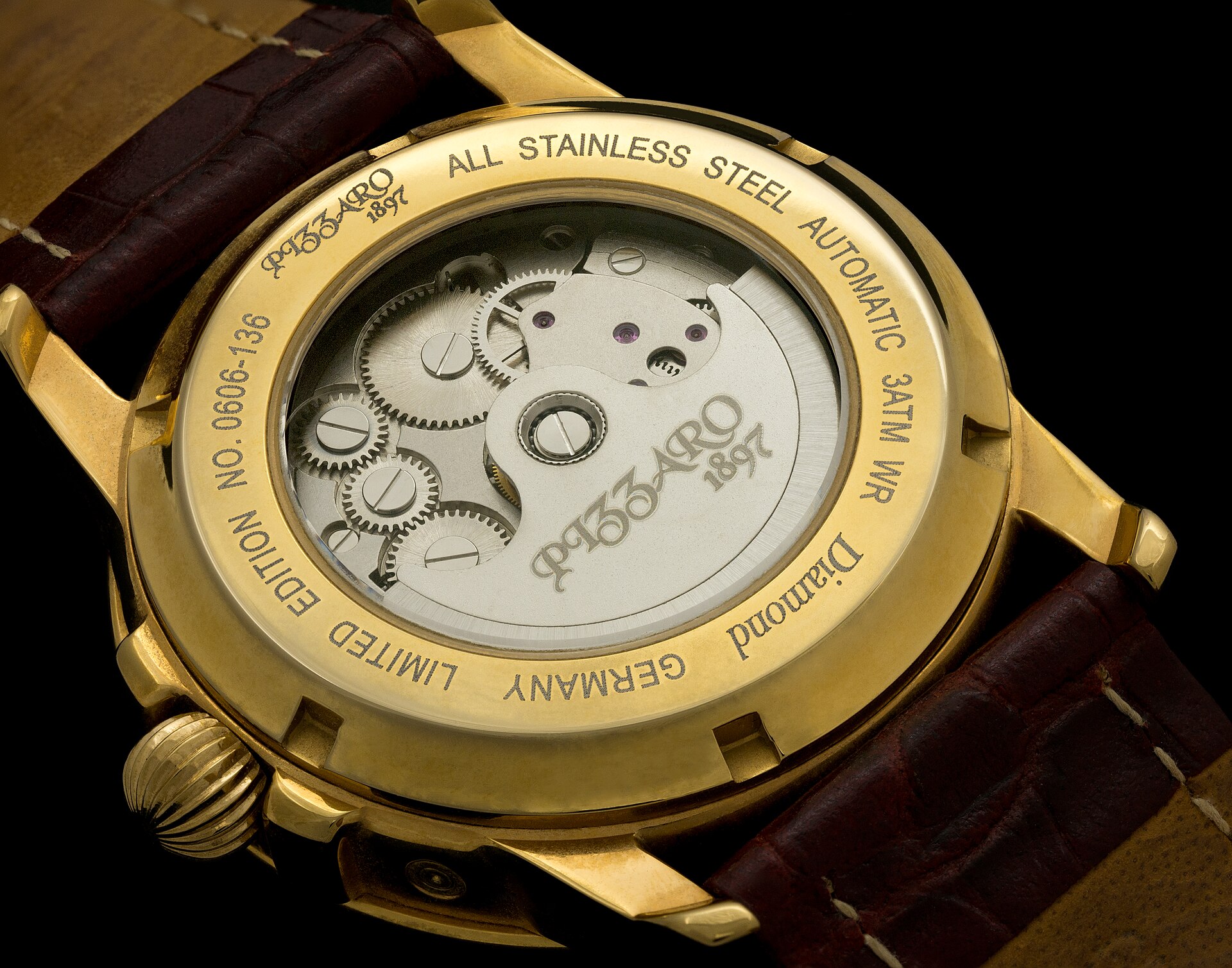
Most watches sit on the left wrist because most people use the right hand for writing, tools and fine control. The quieter wrist exposes the watch to fewer impacts, while the dominant hand can fasten the strap and operate a crown placed at three o’clock. That practical feedback loop became a design convention: manufacturers built for the most common wearing position, and the familiar design made that position feel like a rule. It is not one. Historical watches used different crown positions and orientations, and a watch belongs on the wrist where it is readable, comfortable and usable.
Pocket watches did not simply shrink onto men’s left arms
Portable watches were carried in pockets, hung from chains and also worn as jewellery long before the modern wristwatch settled into one form. Small bracelet watches were associated particularly with women in the nineteenth century. Men’s pocket watches could be larger and protected inside clothing, and checking one was acceptable when the user had a free hand. Industrial schedules, navigation and railway timekeeping made portable accuracy valuable without dictating a wrist.
The Smithsonian’s history of the pocket watch notes that formal wristwatches existed in the eighteenth and nineteenth centuries, often as women’s jewellery, and that the decisive shift in men’s use came around the First World War. That is a transition in social acceptance and practical demand, not an invention on a single date. Smithsonian Magazine: pocket watches and the wristwatch transition
Early strap watches often adapted movements and habits from pocket watches. Designers had to decide where the crown belonged and how twelve o’clock should align with the strap. Those choices were not inevitable. A watch that seems “backwards” today may reflect a period before the interface standardised rather than a special product for a particular hand.
War made glanceable time operationally useful
A soldier coordinating movement, artillery or communications could not always spare both hands to retrieve and return a pocket watch. A protected watch strapped to the wrist could be read quickly. Military use did not instantly put every civilian watch on the left, but it gave men a powerful reason to treat a bracelet timepiece as equipment rather than jewellery.
The National WWII Museum describes the wristwatch as a product of First World War conditions and notes that, by the end of the 1920s, wristwatches were outselling pocket watches by substantial margins. Its later A-11 examples also show why synchronisation and a stopping seconds hand mattered to military operations. National WWII Museum: military wristwatch history
This history supports the practical rise of the wristwatch but not every popular origin story. Claims that soldiers universally wore watches on a particular wrist because the other held a sword are too neat. Armament, task, handedness and watch design varied, and early watches were worn on either arm. The evidence is stronger for quick access and synchronisation than for one battlefield rule determining modern etiquette.
The modern layout standardised in the 1910s
A Smithsonian collection record for an Elgin wristwatch made around 1917 explains that early wristwatches placed crowns at either three or nine o’clock and even disagreed on dial orientation. By the 1910s, crown position and strap orientation had largely conformed to the style familiar today. That object evidence directly contradicts the idea that left-wrist wear was fixed for centuries. Smithsonian: Elgin wristwatch, circa 1917
On the now-common layout, the crown projects from the right side of the case. A watch on the left wrist places that control where the right hand can pinch it. Mechanical watches once needed frequent winding, so access mattered. Many makers advise removing a watch before winding or setting it to avoid side-loading the stem, but the layout still communicates an assumed wearer.
Cases, straps and mass reinforced the convention. Keeping a watch off the dominant hand generally reduces clashes with desks, tools and door frames and makes writing more comfortable. A right-handed person can fasten a buckle on the left wrist with the more dexterous hand. None of those advantages is universal, but together they make the left wrist the statistically convenient default.
Left-handed wearers expose the limits of the rule
A left-handed person may prefer the right wrist for exactly the same reason a right-handed person prefers the left. A standard three-o’clock crown then points away from the hand rather than towards it, and it is harder to adjust while worn. Some manufacturers offer left-crown or “destro” watches designed to be worn on the right wrist and operated by the left hand. Others use crowns at four, eight, nine or twelve o’clock.
People are not perfectly divided by writing hand. Work, injury, sport, jewellery, tattoos, medical sensors and habit can determine the wrist. A surgeon, musician or craft worker may remove a watch altogether during a task. A driver does not gain a universal safety advantage from one wrist; looking away from the road to read any watch can be distracting. Comfort and safe use beat a claimed etiquette rule.
The old article’s assertion that wearing a watch on the “wrong” wrist is rude has no credible basis. A watch can breach a dress code by being distracting, sounding alarms or being unsafe around machinery, but the side itself carries no dependable social message. A person seeing a watch on the right wrist cannot infer handedness, status or knowledge of etiquette.
Smartwatches turn orientation into a setting
Digital displays do not need a winding crown, yet physical controls, gesture detection and health sensors still depend on orientation. Many smartwatches ask which wrist is used and let the display rotate so the crown or buttons can face either direction. The device can then interpret movement and present controls consistently. That software choice makes visible what mechanical watch design hides: wearing side is an interface assumption.
Sensor instructions can be more important than tradition. The band should usually be snug enough for the sensor to maintain contact without restricting circulation, and tattoos, skin condition, cold, motion and fit can affect readings. A consumer should follow the device maker’s instructions for an ECG, oxygen estimate or safety feature rather than move the watch merely to match a style rule.
Accessibility matters too. Limited movement in one hand may determine where the watch can be fastened or which crown direction is usable. Voice control and touch screens can reduce dependence on a crown while creating new interaction problems. A thoughtful design supports both wrists instead of treating one orientation as a defective user.
Choose the wrist by a four-part test
First, identify the hand used for most impact-prone or fine work. The opposite wrist often protects the watch and reduces interference. Second, check whether the crown or pushers press into the hand during wrist extension; moving the watch above the wrist bone or changing side may help. Third, test the strap through a day rather than for a minute. Fourth, confirm that any smartwatch orientation and sensor settings match the actual wrist.
For a mechanical watch, set and wind it according to the manufacturer’s instructions, preferably off the wrist when advised. For a large case, comfort may depend more on lug-to-lug length and strap fit than on handedness. For sport, machinery or clinical work, the safest choice may be a different watch, protective placement or no wristwear. History explains the convention; it does not override the task.
The left wrist therefore won by accumulation rather than decree: right-handedness is common, the non-dominant wrist is usually less busy, crowns standardised on the right side and mass production reinforced the familiar layout. The history is useful because it removes the mythology. Wear a watch where its controls work, its case stays clear of the job and its presence does not demand attention.
.jpg)