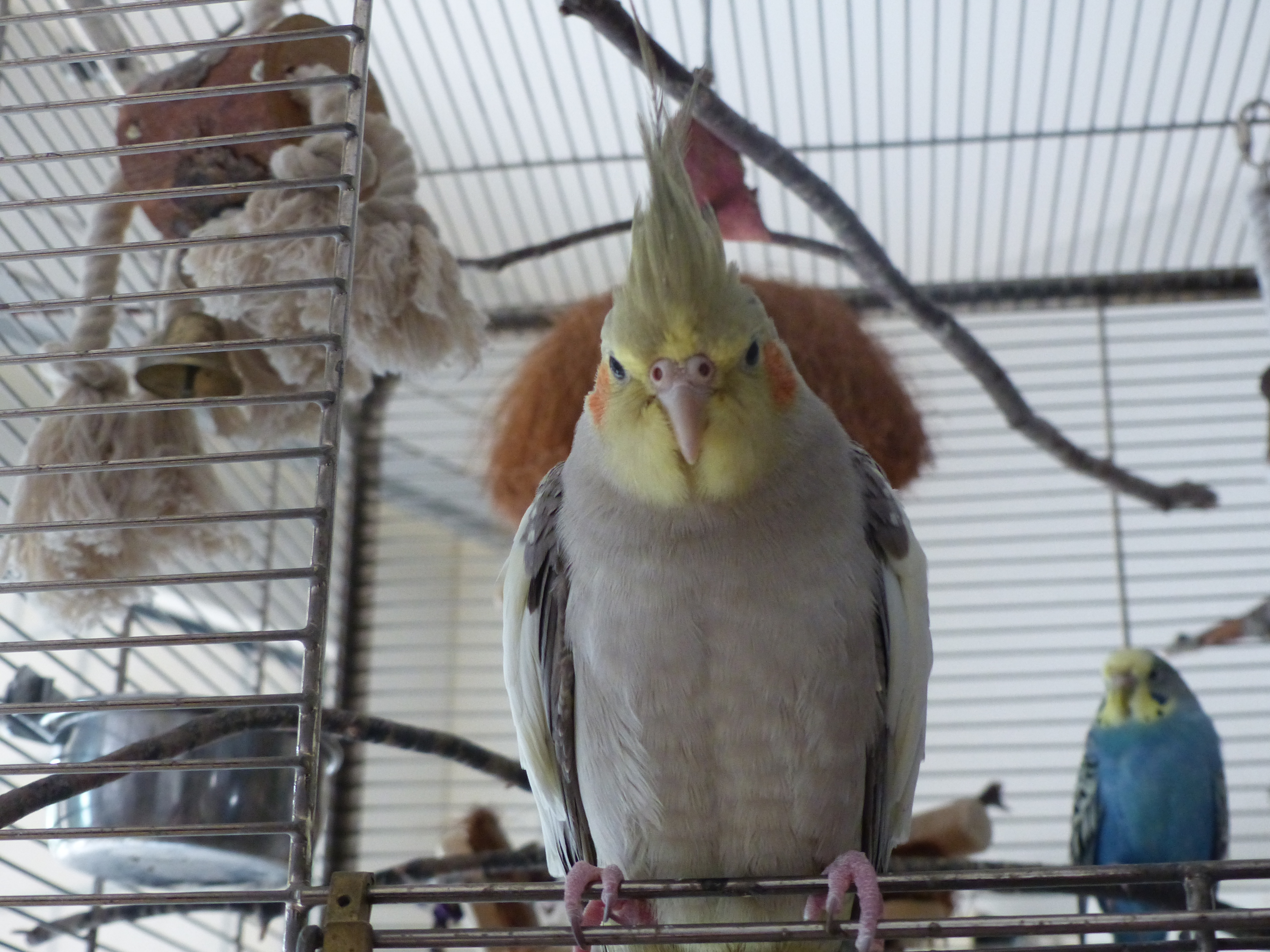
A cockatiel is small enough to look like an easy first parrot. That impression is only partly right. These Australian birds are often gentle and sociable, but they can live well into their teens, spread fine feather dust, call loudly and become ill when fed mainly seed. The useful question is not whether cockatiels are friendly. It is whether your household can provide safe air, daily company, room to move and consistent care for many years.
The quick facts are a commitment, not a shopping list
Cockatiels are small parrots in the cockatoo family. VCA Animal Hospitals gives an average body weight of 80 to 95 grams, a length of about 32 centimetres and an average lifespan of 10 to 14 years, with some birds reaching 24. That range makes a cockatiel closer to a long household relationship than a short-lived starter pet. VCA cockatiel overview
The familiar wild-type bird is mostly grey. Adult males commonly develop a brighter yellow face after the first major moult, while females often retain bars beneath the tail and spots beneath the wings. Colour mutations can make visual sexing unreliable, and young birds may resemble females until mature plumage appears at roughly nine to twelve months. DNA testing or an avian veterinarian is more dependable when sex matters for medical or reproductive planning.
Personality is not guaranteed by colour or sex. A well-socialised bird may seek head scratches, whistle back to people and enjoy sharing a room without wanting to be held. Another may be cautious, territorial around a cage or frightened of hands. Ownership works better when affection is treated as voluntary behaviour to earn, not a feature included with purchase.
Daily social contact is part of basic welfare
Cockatiels are social flock birds. The RSPCA advises that birds should be able to behave socially and notes that many companion species benefit from compatible bird company, while also needing enough space, perches and resources to avoid conflict. A human household can provide interaction, but a radio left playing is not a substitute for a responsive companion. RSPCA bird environment guidance
A single cockatiel therefore needs predictable time with people every day. That includes calm conversation, training, supervised movement and a chance to choose contact. A pair may meet more of each other’s social needs, but pairing is not automatic: introductions require space and observation, and two birds still need enrichment and healthcare. An owner should also expect the relationship with people to change when birds bond closely to each other.
Signals are often clearer than owners think. A flattened crest, leaning away, open beak or repeated attempt to escape means pause. A relaxed bird may softly grind its beak, preen, approach voluntarily or lower its head for a scratch. Pet the head and neck rather than stroking the back or beneath the wings, which can stimulate reproductive behaviour. Short, reward-based sessions protect trust better than restraint used for convenience.
A cage is a safe base, not the bird’s whole world
Choose the largest practical enclosure with horizontal room for movement, bar spacing that cannot trap the head and doors that lock securely. Width matters because birds move laterally. Provide natural-wood perches of varied safe diameters so the feet do not grip one uniform shape all day. Sandpaper perch covers can abrade feet and do not replace nail care.
Place food and water where droppings cannot fall into them, and offer more than one station when birds share an enclosure. Rotate shreddable toys, foraging tasks and safe branches rather than packing every centimetre with objects. Mirrors can trigger fixation or reproductive behaviour in some birds. Strings, frayed fibres, open clips and small detachable parts deserve the same inspection you would give a child’s toy, because toes, beaks and intestines can become trapped.
Supervised out-of-cage time should happen in a bird-proofed room. Merck lists windows, mirrors, ceiling fans, hot surfaces, electrical cords, open water and other pets among common household hazards. Close doors and windows, switch fans off, cover dangerous glass until the bird understands it, and remove cats and dogs rather than assuming calm behaviour equals safety. Merck household hazards for birds
Seed is a food, not a complete diet
Wild cockatiels eat a varied seasonal diet in semi-arid Australia. In a bowl, a seed-heavy mix lets a bird select energy-dense favourites while leaving essential nutrients behind. VCA warns that seed-only diets are nutritionally incomplete, and the RSPCA recommends that seed form no more than roughly a tenth of the diet for small parrots such as cockatiels. VCA cockatiel feeding guide RSPCA bird diet guidance
A veterinarian may recommend a formulated pellet as the nutritional base, supplemented with a varied selection of bird-safe vegetables and smaller amounts of fruit and seed. Conversion must be gradual and monitored: a bird can appear to investigate new pellets while eating too little. Weighing the bird on a gram scale at the same time each day during a diet change gives more useful evidence than looking at a full dish.
Fresh water and food dishes should be cleaned daily. Remove moist food before it spoils. Never offer avocado, which Merck identifies as poisonous to birds, and avoid alcohol, caffeine, chocolate and highly salty food. Treats should support training without displacing the balanced diet. Because an individual bird’s health, current intake and weight affect the safest transition, major diet changes belong in a plan made with an avian veterinarian.
Air quality can become an emergency
Bird respiratory systems are exceptionally efficient and therefore vulnerable to airborne toxins. Merck reports that fumes from overheated polytetrafluoroethylene, commonly known as PTFE or non-stick coating, can cause rapid breathing, incoordination, seizures and sudden death. The risk is not limited to frying pans: coatings can appear on appliances, heat lamps and self-cleaning ovens. Merck toxicoses of pet birds
Keep birds entirely away from kitchens during cooking and investigate coated appliances before use. Smoke, vaping aerosols, scented candles, incense, essential-oil diffusers, cleaning sprays, paint fumes and aerosol products can also harm or irritate birds. Moving the cage across the room is not adequate protection when the contaminant is in the air. Ventilation helps, but prevention is safer.
Cockatiels also produce powder down: very fine feather material that settles on surfaces. Routine cleaning and a suitable air cleaner can reduce dust, but a bird may be a poor fit for a household with serious respiratory sensitivity. Do not place an air purifier so it blows a constant draught on the cage, and avoid devices that intentionally generate ozone or ions without clear safety evidence.
Learn the bird’s normal before illness hides it
Prey animals often conceal weakness. By the time a cockatiel sits fluffed on the cage floor, breathes with a tail bob, stops eating or becomes markedly quiet, delay can be dangerous. Other warning signs include a voice change, persistent discharge, vomiting, sudden balance problems, altered droppings or a measurable drop in weight. Contact an avian veterinarian promptly rather than trying leftover medicine or waiting for several symptoms to agree.
VCA recommends regular veterinary examinations and notes that a new bird should be checked soon after purchase. An avian clinician can assess body condition, diet, droppings, skin, beak and feet, discuss disease testing and establish a baseline weight. “Avian” matters: dog-and-cat practice does not automatically include bird expertise. VCA veterinary care for cockatiels
Quarantine a new bird separately from resident birds and follow veterinary advice about duration and testing. Wash hands after handling birds, cages and droppings. Psittacosis can pass between birds and humans, so persistent respiratory or systemic illness in a recently exposed person should be discussed with a doctor, with bird contact mentioned explicitly.
The honest pre-adoption test
Before bringing one home, price an appropriate enclosure, safe furnishings, quality food, an avian examination and an emergency visit. Confirm who will provide daily care during travel, where the bird will live during kitchen use and whether everyone can accept calls, scattered food and dust. Check local rules and choose a captive-bred or responsibly rehomed bird with documented origin; never take a wild bird.
Then test the timeline. A child who wants a cockatiel now may leave home while the bird is still alive. A renter may face noise clauses or future landlords. A household planning pregnancy, relocation or extended travel needs a named adult who remains responsible. Rehoming is sometimes necessary, but planning as though it will be easy transfers the risk to the bird.
Cockatiels can reward patient care with curiosity, communication and a relationship that becomes more individual over time. The best owners are not the ones who know the most charming facts. They are the ones prepared for the ordinary repetitions: fresh food, clean water, safe flight, quiet sleep, training, dusting and noticing when a small change means something is wrong.
