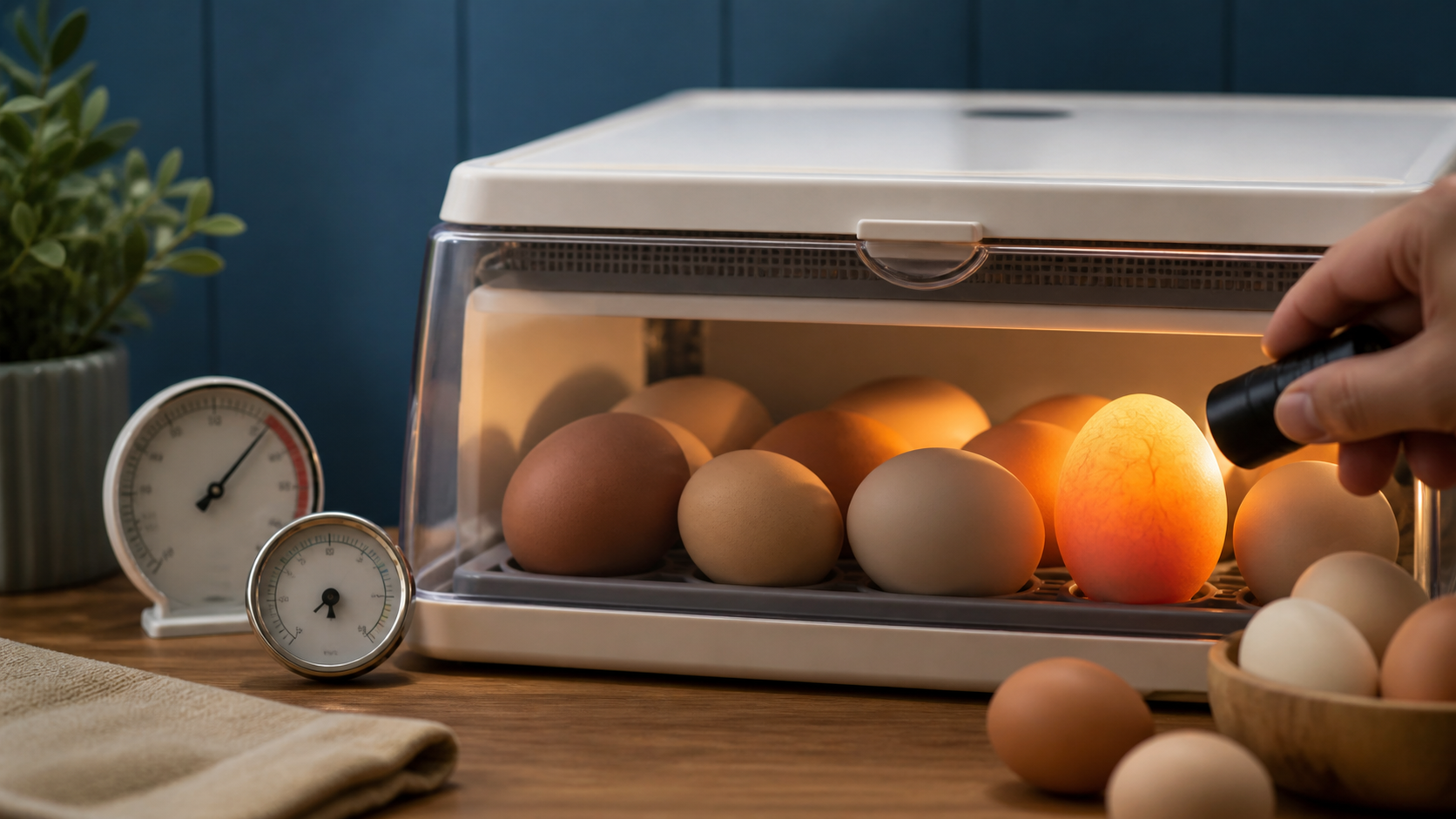
A failed hatch rarely has one visible cause. Fertility, storage, temperature, humidity, ventilation, turning and sanitation all leave clues—and the incubator log is more useful than guesswork.
Begin with the timeline, not the shell
Chicken eggs normally hatch at about 21 days, but a calendar date is not a diagnosis. A hatch that runs early can point to sustained high temperature; a late or uneven hatch can point to low temperature, warm and cool zones in the machine, or eggs that were old or stored poorly before setting. Mississippi State incubation factors Mississippi State troubleshooting table
Write down when each egg was set, the incubator model, whether it uses forced or still air, and the temperature and humidity readings throughout the cycle. A single reading taken after a problem appears cannot reconstruct three weeks of conditions.
The five controls work together
University extension guidance treats temperature, humidity, ventilation, turning and sanitation as one system. For small forced-air incubators, Mississippi State uses about 100°F as its benchmark, while still-air machines require a different reading because heat layers inside the cabinet. The manufacturer’s instructions for the exact machine should take priority over a generic number copied from the internet. Hatchery management guide
Humidity controls how quickly an egg loses moisture. Too much and too little can both reduce hatchability, so adding water by instinct may make the diagnosis harder. Check the hygrometer, the water-surface instructions and, when you have the training to do so, the expected development of the air cell.
Ventilation matters more as embryos grow. Turning keeps the developing embryo from remaining against one surface, but it stops before the final hatch period. Mississippi State advises turning chicken eggs during the first 18 days and leaving them unturned during the final three days. Hatching Quality Chicks
Candling can separate an empty egg from a delayed hatch
Candling shines a bright light through the shell in a dark room. At the right stage, a developing egg may show blood vessels, a dark embryo and movement; an infertile or very early failed egg may remain comparatively clear. Dark shells and late-stage eggs are harder to interpret, so uncertainty is normal.
Handle eggs gently, keep the inspection brief and avoid repeated cooling. If an egg is cracked, leaking, smells abnormal or threatens contamination, follow your extension service or veterinarian’s biosecurity guidance rather than opening it indoors to investigate.
Do not rush to “help” a chick out
Hatching is a staged process. A chick can pause for many hours between making the first hole and completing the hatch while it absorbs remaining yolk and the blood vessels in the membrane close. Opening the incubator repeatedly can drop humidity at exactly the wrong moment.
Peeling shell or membrane can cause bleeding, infection or injury when the chick is not ready. If a live chick appears stuck or distressed, get advice from an experienced poultry keeper, avian veterinarian or local extension specialist who can assess the timing and conditions. A web article cannot safely decide when intervention is warranted.
Turn one failed hatch into a better record
After the hatch window has clearly passed, compare outcomes egg by egg: clear at candling, stopped early, developed but failed to pip, pipped but did not emerge, or hatched weak. Those patterns can point toward different problems, but they do not prove one cause on their own.
Before the next attempt, verify thermometers and hygrometers, run the incubator empty, check the turning mechanism and vents, review how long the eggs were stored, and improve cleaning and handling. The useful question is not “what single thing went wrong?” but “which part of the recorded process can be checked and controlled next time?”