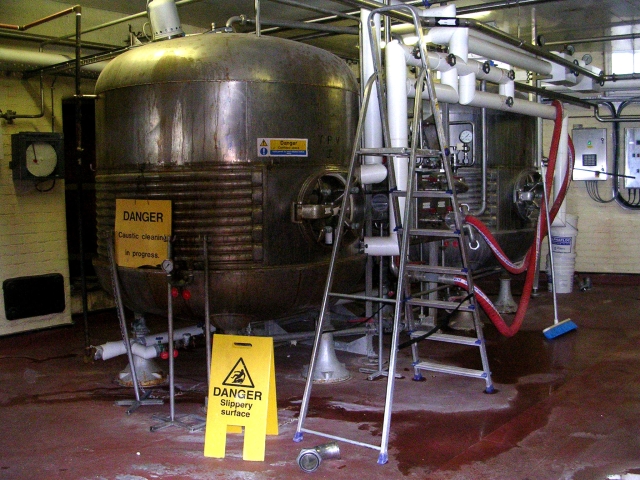
A brewing sanitiser has a narrow job: reduce microorganisms on a surface that has already been cleaned. It is not a detergent, a preservative for beer or an ingredient to add “just in case.” Iodophor is an iodine-based food-contact sanitiser that can perform that job with short contact times when it is diluted exactly as its current label requires. The old Articleous article blurred cleaning and sanitising, proposed adding iodophor to brewing liquid and offered salt and household chemicals as casual alternatives. Those shortcuts are not merely imprecise. They remove the concentration, surface, contact time and rinsing conditions that make a sanitising claim valid.
Cleaning and sanitising are separate operations
Cleaning removes visible soil, dried wort, hop matter, yeast film, oil and mineral deposit. Sanitising follows on a clean surface and reduces microorganisms to the level specified by the product and method. Soil can shield microbes and consume active chemistry, so increasing sanitiser strength does not repair poor cleaning. A vessel that looks clean under dim light may still have a ring, valve cavity or scratched plastic surface that defeats the next step.
Disassemble equipment as far as its manufacturer intends. Rinse fresh residue before it dries, wash with a cleaner compatible with the material, apply mechanical action where safe, and inspect in good light. Pay particular attention to taps, poppets, dip tubes, gaskets, transfer hoses and sample ports. Rinse the cleaner as directed. Only then prepare the sanitiser.
The Brewers Association states the principle plainly in its sanitation guidance: detergents do not sanitise. It also distinguishes products intended for food-contact surfaces from disinfectants intended for other environments. For a home brewer, the safe rule is to use a current product whose label explicitly covers the surface and intended food-contact use. Brewers Association: recommended sanitisers and disinfectants
Iodophor is iodine carried in a soluble complex
An iodophor combines iodine with a carrier that improves solubility and controlled release. In brewing products, a measured dilution provides available iodine for sanitising hard, non-porous food-contact surfaces. Concentrate and working solution are not interchangeable. The concentrate can irritate or damage, while an under-strength working solution may not achieve the labelled result.
The brown or amber colour of a solution is not a precise concentration test. Water chemistry, product age, organic load and light can affect appearance and performance. If a process depends on maintaining a range, use test strips intended for available iodine and the relevant concentration. Test the mixed solution, not a guess based on drops, capfuls or tint.
Iodophor may stain some plastics and porous materials, especially with excessive concentration or contact. Staining is not evidence of improved sanitation. Compatibility varies across elastomers, metals and finishes, so check both the sanitiser and equipment instructions. Do not soak parts indefinitely because a short labelled contact time feels too brief.
One label example shows why the exact product matters
The US Environmental Protection Agency label for BTF Iodophor gives a brewery and food-contact working concentration of 12.5 parts per million available iodine. One labelled mixing example is one-quarter US fluid ounce in 2.5 US gallons of cool or lukewarm water, with two minutes of immersion or contact, followed by draining and air drying without towel drying. The same label says never to use hot water. EPA label: BTF Iodophor
That example is not a universal iodophor recipe. Products can differ in concentrate strength, permitted use, contact time and whether a potable-water rinse is required at a given concentration. Formulations and registrations can change. Use the current container label and safety data for the product in hand, in the country where it is being used. If a shop has decanted the product without its directions, obtain the manufacturer’s documentation before use.
Calculate from the batch volume rather than approximating. One-quarter US fluid ounce is about 7.4 millilitres, and 2.5 US gallons is about 9.46 litres, but translated numbers should not silently replace the labelled units. A syringe or graduated measure reserved for chemical use is more reliable than a kitchen spoon. Label the measure and never return unused concentrate to the original container.
Contact means complete wetting for the full interval
EPA food-contact guidance requires labels to state the concentration, application method, thorough wetting and minimum contact time. It also distinguishes treatments that may drain and air dry from those that require a potable-water rinse. These details are part of the authorised use, not optional technique. EPA: food-contact surface sanitising directions
Start the clock after the surface is fully wet. A splash that drains immediately has not delivered a two-minute contact. Closed vessels can often be rotated so all internal surfaces remain coated; hoses and valves need solution through their full pathway. Foam or colour does not prove that a hidden pocket was reached. Use enough working solution and a method that exposes each surface.
After the labelled contact period, drain or rinse exactly as directed. Do not wipe a no-rinse surface with a kitchen towel; the towel can recontaminate it. Protect air-drying parts from dust and handling. A “no-rinse” direction applies only at the labelled concentration and use. It does not authorise leaving a pool of over-strength concentrate in a fermenter.
Never add iodophor to wort or finished beer
Food-contact sanitiser is applied to equipment before the food touches it. It is not dosed into wort, must or beer as a microbial insurance policy. An accidental residual film after proper drain-and-air-dry use is categorically different from pouring sanitiser into the product. Direct addition can create excessive iodine exposure, off flavour, yeast damage and an unapproved use.
If sanitiser enters a batch because a vessel was not drained, record the product, concentration and estimated quantity and contact the manufacturer or an appropriate food-safety authority. Do not rely on smell, colour or “yeast will use it up.” Where the amount is uncertain or materially outside labelled residual use, discarding the batch can be the responsible decision.
The same boundary applies to packaged beer. Adding a household antiseptic to a suspect bottle does not make it safe. If spoilage, contamination or package pressure is suspected, isolate the package and assess the failure. Sanitiser prevents a known risk on equipment; it does not turn an unknown beverage into a validated food product after the fact.
Alternatives have their own operating windows
Acid-anionic no-rinse sanitisers are popular in small breweries because they work quickly on clean surfaces and can be convenient in hard-water conditions, depending on formulation. Use the product’s measured dilution, contact time and compatibility instructions. Persistent foam is not automatically harmful when a labelled no-rinse product is used correctly, but concentrate should never be judged or dosed by foam alone.
Peracetic acid is a powerful oxidising sanitiser used in professional food and beverage plants. It can work across a useful temperature range and decomposes without a chlorine residue, but concentrate is corrosive and can cause serious injury. Ventilation, closed dosing, personal protective equipment and trained handling matter. A professional product is not a casual homebrew upgrade simply because a forum calls it effective.
Chlorine-based products can sanitise compatible surfaces at an appropriate label concentration, yet organic soil consumes them and residues can contribute medicinal chlorophenol flavours if they meet phenolic compounds. Rinsing requirements and corrosion risks depend on product and use. Heat can sanitise or sterilise some equipment when time and temperature are validated, but it can deform plastic or damage seals. Choose by the surface and process, not by a generic ranking.
Salt, grocery-store iodine and improvised mixtures are not alternatives
Table salt at culinary concentration is not a food-contact surface sanitiser for brewing. Salting preserves some foods only when concentration, water activity, time and product have been designed together. A salty rinse in a fermenter offers no validated microbial reduction and can pit susceptible stainless steel or leave residue. It should not appear on a list beside registered brewing sanitisers.
Tincture of iodine and povidone-iodine sold for skin treatment have different carriers, concentrations and labelled uses. A product safe for intact skin is not automatically authorised for a food-contact vessel, and a drop-count recipe does not resolve that difference. Hydrogen peroxide from a pharmacy also varies in intended use and is not made into a reliable brewery sanitiser by combining it with vinegar, salt or another household chemical.
Never mix cleaning or sanitising chemicals unless the product manufacturer explicitly instructs it. Acids and chlorine products can release toxic gas; oxidisers can react violently or generate heat. More active ingredients do not produce a broader safety margin. They produce a reaction whose products and exposure may be unknown.
A repeatable sanitation record is short and specific
Record the product name, lot or purchase date, label concentration, water volume, concentrate volume, measured test-strip result when used, preparation time and discard time. Note the equipment treated and whether it was drained, air-dried or rinsed according to the label. Commercial breweries need more formal procedures, but the same fields prevent a home brewer from reconstructing a critical dilution from memory.
Replace working solution when the label requires, when it is visibly soiled or when testing shows it outside range. Store concentrate in its original labelled container, closed and away from children, food and incompatible chemicals. Do not pour an unlabelled remainder into a drinks bottle. Follow local disposal instructions; a solution suitable for one drain or septic system may not be suitable everywhere.
The choice among iodophor and alternatives is less important than disciplined use. A clean surface, the right registered product, an accurate dilution, complete wetting and the full contact time form a defensible process. Guessing a capful, adding sanitiser to beer or substituting salt abandons that process. Brewing sanitation is not a secret chemistry trick. It is a sequence that should remain boring enough to repeat every time.
