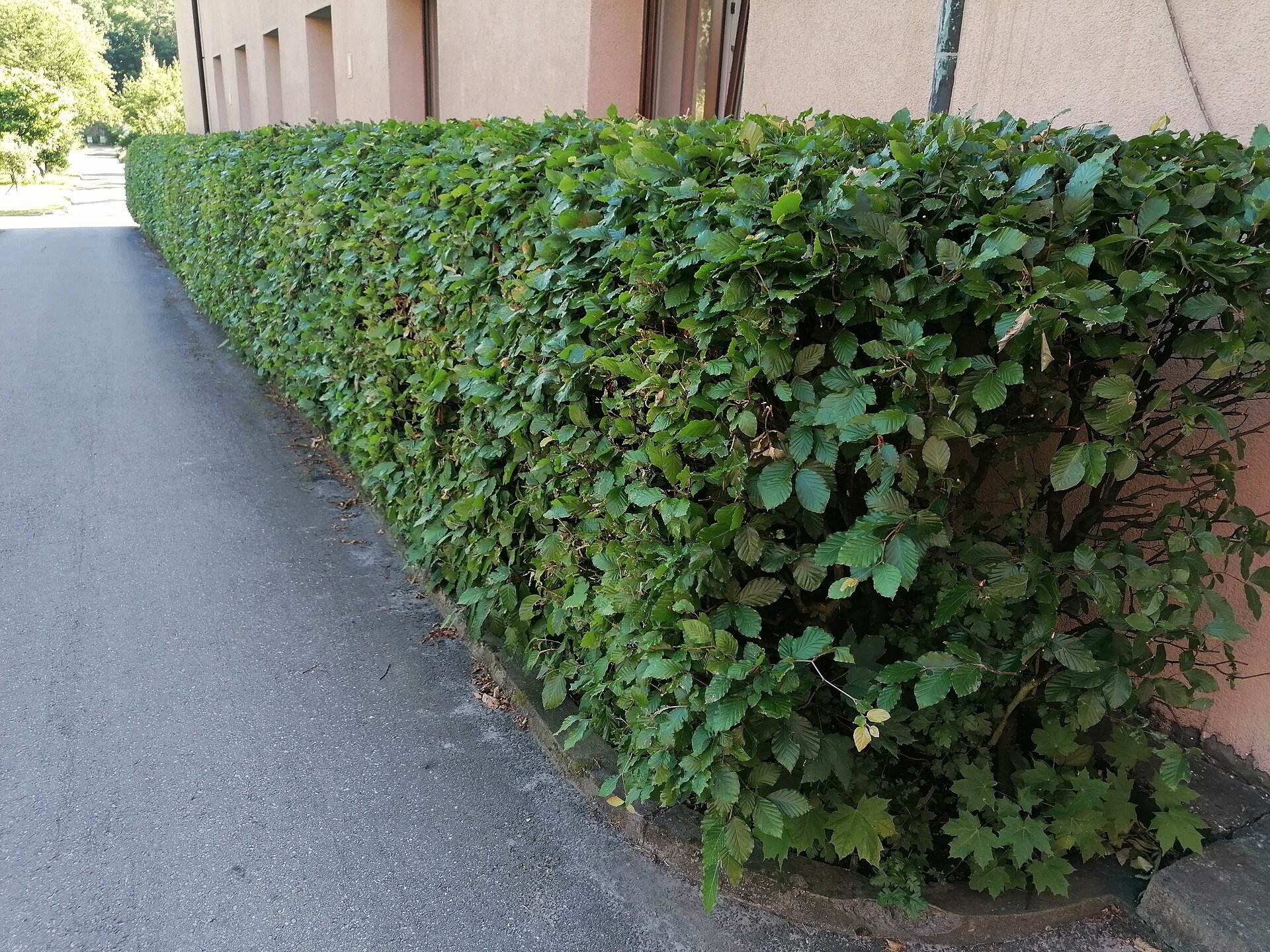
The most important hedge decision is not whether box, beech or laurel looks best in a catalogue. It is whether the plant can live in the garden you have and remain at the size you can maintain. Light, winter cold, wind, salt, soil moisture, root space and the number of cuts you are willing to make each year eliminate unsuitable candidates before leaf colour enters the discussion. A hedge is a row of woody plants sharing the same narrow strip of soil; a mistake is multiplied along the whole boundary.
Write the hedge’s job description before shopping
A boundary can need privacy, wind filtering, animal control, noise softening, a low formal edge, seasonal flowers or food and cover for wildlife. Those are different jobs. A dense evergreen can block a winter view but cast a permanent shadow. A deciduous hedge loses leaves, yet its branching may still provide screening and can filter wind without the turbulence produced by a solid wall. A thorny mixed hedge may be excellent habitat and a poor choice beside a narrow path used by children.
The Royal Horticultural Society advises deciding first whether the hedge should be evergreen or deciduous, formal or informal, and what maintained height it must reach. It then puts soil, situation and annual maintenance ahead of the plant list. That order matters because a label such as “fast-growing” says nothing about whether the finished hedge is sustainable in the available width. RHS: choosing plants for hedges
Measure the whole run, including gates, utilities and sight lines. Record the width you can surrender at ground and shoulder height, not just the line where trunks will stand. Check where shade falls in midsummer and winter. Note standing water after rain, drying wind, reflected heat, road salt and competition from established trees. A two-metre screen squeezed into a 40-centimetre strip will require a species and training system that can actually hold that profile.
Climate is more than the lowest winter temperature
Hardiness zones describe an area’s typical annual extreme minimum temperature. They are a filter, not a guarantee. A plant within the nominal zone can still fail in waterlogged winter soil, a drying coastal wind, an exposed frost pocket or repeated freeze-thaw cycles. Conversely, a sheltered urban wall can create a warmer microclimate but also increase summer heat and drought. Use the current map for your country and then inspect the exact boundary.
The USDA’s Plant Hardiness Zone Map is explicitly based on average annual extreme minimum winter temperature. It does not map drainage, heat, humidity, snow cover or salt. Equivalent national and regional systems use different scales, so a zone number copied from a foreign nursery cannot be transferred without checking the underlying temperature band. USDA: Plant Hardiness Zone Map
Cold exposure also changes the privacy trade-off. European beech and hornbeam are deciduous, but clipped plants often retain dry leaves through part of winter; retention varies by site and weather and is not the same as evergreen foliage. Yew can tolerate shade and repeated clipping once established but resents poorly drained soil. Griselinia and some pittosporums suit milder maritime areas, not every cold inland garden. Local hedges that have thrived for years are better evidence than a generic “best hedge” ranking.
Read the soil as a growing system
Dig test holes at several points because a boundary beside a new house may cross imported topsoil, compacted subsoil and builders’ rubble. After heavy rain, observe how long water remains. In dry weather, check how quickly the strip loses moisture. A pH test can rule out plants with strong preferences, but structure and drainage often decide survival. Improving one planting hole like a pot can trap roots in a wet pocket; soil preparation should address the full hedge line.
Remove perennial weeds before planting. Loosen compaction across a useful width without destroying nearby utilities or major tree roots. Organic matter can improve water holding and structure, but it cannot turn a permanently waterlogged strip into free-draining ground. If the site is wet, choose plants that tolerate it or correct the drainage lawfully. If it is drought-prone, select accordingly and plan irrigation for establishment rather than expecting a newly planted “drought-tolerant” hedge to manage without roots.
Bare-root plants are economical during dormancy and can establish well when handled before roots dry. Container plants extend the season but may be root-bound. Whatever the format, set the root flare at the correct level, spread roots naturally, firm soil without crushing it and water the entire root zone. Plant spacing depends on species, supplied size and whether the hedge is a single or staggered row; use a reputable nursery’s specification for the exact stock rather than a universal plants-per-metre formula.
Evergreen, deciduous and mixed hedges make different bargains
RHS guidance notes that evergreens provide year-round shelter and privacy but commonly need annual or twice-yearly pruning. Most overgrown conifers, yew excepted, do not regenerate from old bare wood. Deciduous hedges give less winter privacy but are generally more forgiving of missed pruning and can filter wind with less damaging turbulence. RHS: evergreen and deciduous hedge trade-offs
A formal hedge depends on uniformity and repeated clipping. Yew, beech, hornbeam, privet and some hollies can make strong formal structures where climate and soil suit them. Box remains visually attractive, but box blight and box-tree moth have made it a higher-risk choice in many European gardens. A mixed hedge accepts variation: hawthorn, blackthorn, hazel, field maple, holly and other locally appropriate shrubs can supply flowers, fruit, shelter and a longer season of interest.
Do not equate “native” with automatically harmless or “non-native” with automatically poor. Local origin can support specialist relationships, while many non-native flowering shrubs provide pollen, shelter or fruit. The better question is what the plant contributes in that place and whether it becomes invasive. Check official regional invasive-species lists before buying. Nursery availability is not proof that a species is responsible near woodland, water or other natural habitat.
The maintenance budget is part of plant selection
Fast growth reaches screening height sooner and creates more material to remove every year. A plant advertised at 60 centimetres of annual growth does not stop when the desired height is reached. Estimate the safe working height, access on both sides, disposal volume and whether ladders or powered tools would be required. If the top cannot be reached from stable ground with appropriate equipment, the design already depends on hired maintenance.
Young deciduous hedges are often cut back to encourage branching near the base. Waiting until a row reaches final height can leave a thin, leggy lower half that top clipping cannot repair. Once formed, a slight batter—wider at the base than the top—helps light reach lower foliage. Timing varies: spring-flowering informal shrubs are normally pruned after flowering, while formal hedges follow species-specific schedules. Hard renovation is possible for some deciduous plants and disastrous for many conifers.
Plan replacement before planting a disease-prone monoculture. A single pest can remove an entire uniform boundary, whereas a compatible mixed hedge spreads risk. Inspect plants at least seasonally for dieback, discoloured foliage, stem damage and blocked irrigation. Correct identification matters: indiscriminate pesticide treatment can harm the predators and pollinators a wildlife hedge was intended to support.
Wildlife value changes how and when you cut
The RHS describes hedges as wildlife corridors supplying shelter and food for birds, insects and small mammals. Hawthorn, for example, offers blossom, nesting structure and autumn fruit; mixing it with blackthorn, hazel and holly can extend habitat functions. Density matters, but maximum clipping is not the same as maximum value. RHS: wildlife-friendly garden plants
Pruning can destroy active nests. RHS guidance advises checking carefully and avoiding hedge cutting during the nesting season; in the UK, the Wildlife and Countryside Act protects active nests. Dates are only a rough cue because birds respond to local conditions. Other countries have their own wildlife rules, so inspect first and stop if an active nest is present. RHS: shrubs and climbers for nesting birds
Berrying plants present another choice: clipping every year immediately after growth can remove the flowering wood or fruit that justified planting them. Alternating sections or cutting less frequently may preserve food and cover, provided the hedge remains safe and within legal boundaries. The best hedge is therefore not the fastest or most fashionable. It is the one that performs the required job, survives the actual site and can be maintained for decades without becoming a burden to the gardener, neighbours or wildlife.
