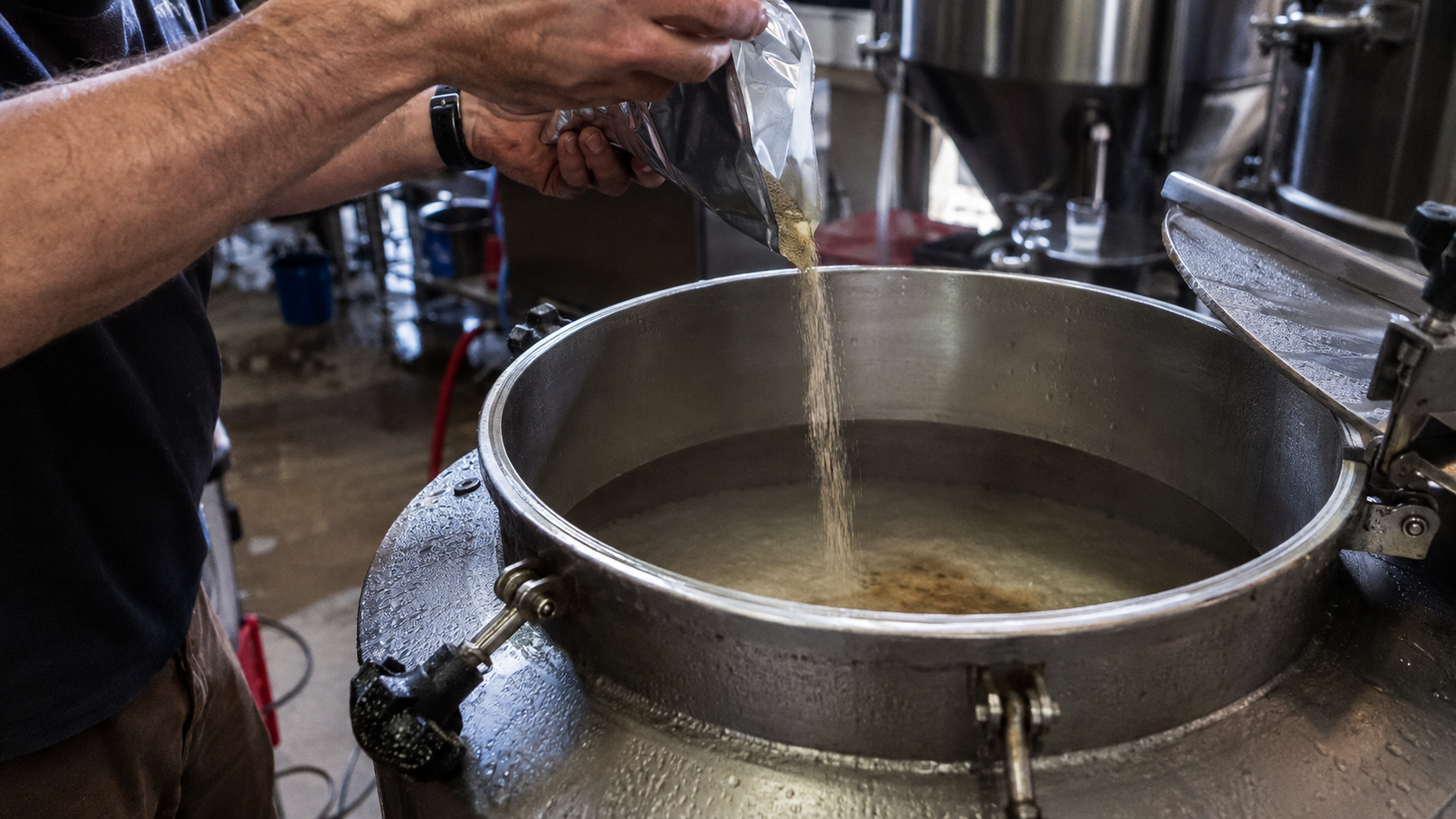
Beer yeast is a living fungal culture that consumes fermentable wort sugars and produces alcohol, carbon dioxide and many of the compounds that shape beer.
The organism is not the packet
Yeasts are fungi. A brewing yeast cell has the ordinary machinery of a eukaryotic cell, including a cell wall, membrane, cytoplasm and nucleus. The wall and membrane help the cell maintain its shape and control exchanges with its environment; the nucleus contains its genetic material. Review: the role of yeasts in fermentation
What a brewer buys is a culture containing many of those cells. Commercial cultures are commonly sold as liquid yeast or active dried yeast. “Dry” does not mean dead: dehydration places viable cells in a form that is easier to store and transport. A sachet is therefore a preparation of living cells in dry form, not a different substance called yeast.
The important distinction is simple: yeast is the organism; liquid and dry yeast are delivery formats.
Ale and lager yeast are different cultures
Classic ale brewing commonly uses strains of Saccharomyces cerevisiae. Traditional lager brewing uses Saccharomyces pastorianus, a hybrid descended from S. cerevisiae and the cold-tolerant species S. eubayanus. A genetic review of lager yeast describes that hybrid ancestry and explains why lager cultures are biologically distinct from ordinary ale strains. Review: modern genetics of lager-brewing yeasts
The familiar labels “top-fermenting” and “bottom-fermenting” survive from brewing history, but they are easy to take too literally. Both ale and lager cells circulate through fermenting liquid. Strains differ in physiology and flocculation—the way cells clump and settle—as well as in the temperatures and production regimes brewers choose for them.
Nor do the labels predict colour or strength. Ales and lagers can each be pale or dark, weak or strong. Yeast lineage and process are more useful distinctions than appearance.
What yeast does after pitching
Fermentation begins with wort, not finished beer. Mashing has already broken much of the malt’s starch into smaller carbohydrates. Brewing yeast can use the fermentable portion, including glucose, maltose and maltotriose, although strains differ in what they can transport and consume.
After pitching, the cells adapt to the wort and begin growing. Brewers often introduce a controlled amount of oxygen before or around this stage because yeast uses oxygen to build membrane components needed for healthy growth. Once alcoholic fermentation is under way, further aeration is normally avoided: oxygen then becomes a route to oxidation and staling rather than a general benefit. Review: the microbiology of malting and brewing
During active fermentation, gravity falls as extract is consumed, ethanol rises and carbon dioxide escapes. Foam and visible airlock activity may become vigorous. At the same time, yeast produces flavour-active compounds including esters, higher alcohols, organic acids, sulfur compounds and vicinal diketones. Their final concentrations depend on both the strain and its conditions, including pitching rate, temperature, oxygen, nutrients and maturation time.
This is why yeast choice is part of recipe design. Some strains are selected for a comparatively neutral profile; others are valued for fruity esters, spicy phenols or their ability to ferment particular sugars. Those descriptions are tendencies, not guarantees detached from the wort and process.
Four controls matter more than folklore
For a beginning brewer, four checks make the biology usable without pretending that one recipe fits every culture.
1. Use the exact strain’s instructions. “Ale yeast” and “lager yeast” are families, not universal operating specifications. Supplier guidance gives the relevant temperature range and handling method for that culture.
2. Control fermentation temperature, not only room temperature. Fermentation releases heat, so the liquid can become warmer than its surroundings. Temperature affects flavour formation and yeast stress as well as speed.
3. Put oxygen in its proper place. Oxygen before or around pitching can support growth; splashing or aerating after fermentation is established can damage beer quality.
4. Measure progress rather than watching bubbles. A hydrometer or density meter compares original gravity with later readings. A quiet airlock can reflect a leak, pressure change or reduced carbon-dioxide release. Repeated gravity readings show whether the extract is still falling and are more informative than bubbles alone. Laboratory guide to brewing and beer analysis
These principles explain why an exact fermentation duration cannot be supplied responsibly without the yeast, wort, temperature and equipment. Visible activity may slow while yeast is still reducing compounds such as acetaldehyde or diacetyl during later fermentation and maturation. Moving the beer simply because the airlock became quiet can cut that work short.
Not every beer uses a single pure culture
Most conventional brewery fermentations use a selected culture, but brewing is broader than two Saccharomyces species. Mixed and spontaneous fermentations can involve successive populations of yeasts and bacteria from ingredients, equipment, barrels and the wider brewhouse environment.
Brettanomyces, for example, can be an unwanted spoilage organism in one brewery and an intentional part of flavour development in another. Calling every non-Saccharomyces yeast a contaminant erases that context. It is more useful to ask whether a microorganism belongs in the intended process and whether the brewer can control the result.
The same principle applies when tasting. In Articleous’s guide to running a useful virtual beer tasting, comparing aroma and flavour works best when the variables are named. Yeast strain and fermentation regime are two of the most consequential variables behind what participants perceive. Articleous virtual beer-tasting explainer
The useful answer
Beer yeast is a living fungal culture, not a flavouring powder. Ale cultures are commonly based on S. cerevisiae; lager cultures on the hybrid S. pastorianus. Once pitched into wort, yeast grows, consumes fermentable sugars and produces alcohol, carbon dioxide and many of the molecules that make one beer smell and taste different from another.
For the drinker, that explains why yeast deserves a place beside malt and hops in any account of beer. For the brewer, it gives a more practical rule: choose a defined culture, follow its range, manage oxygen and temperature at the right stage, and use measurements—not bubbles alone—to decide what the fermentation is doing.