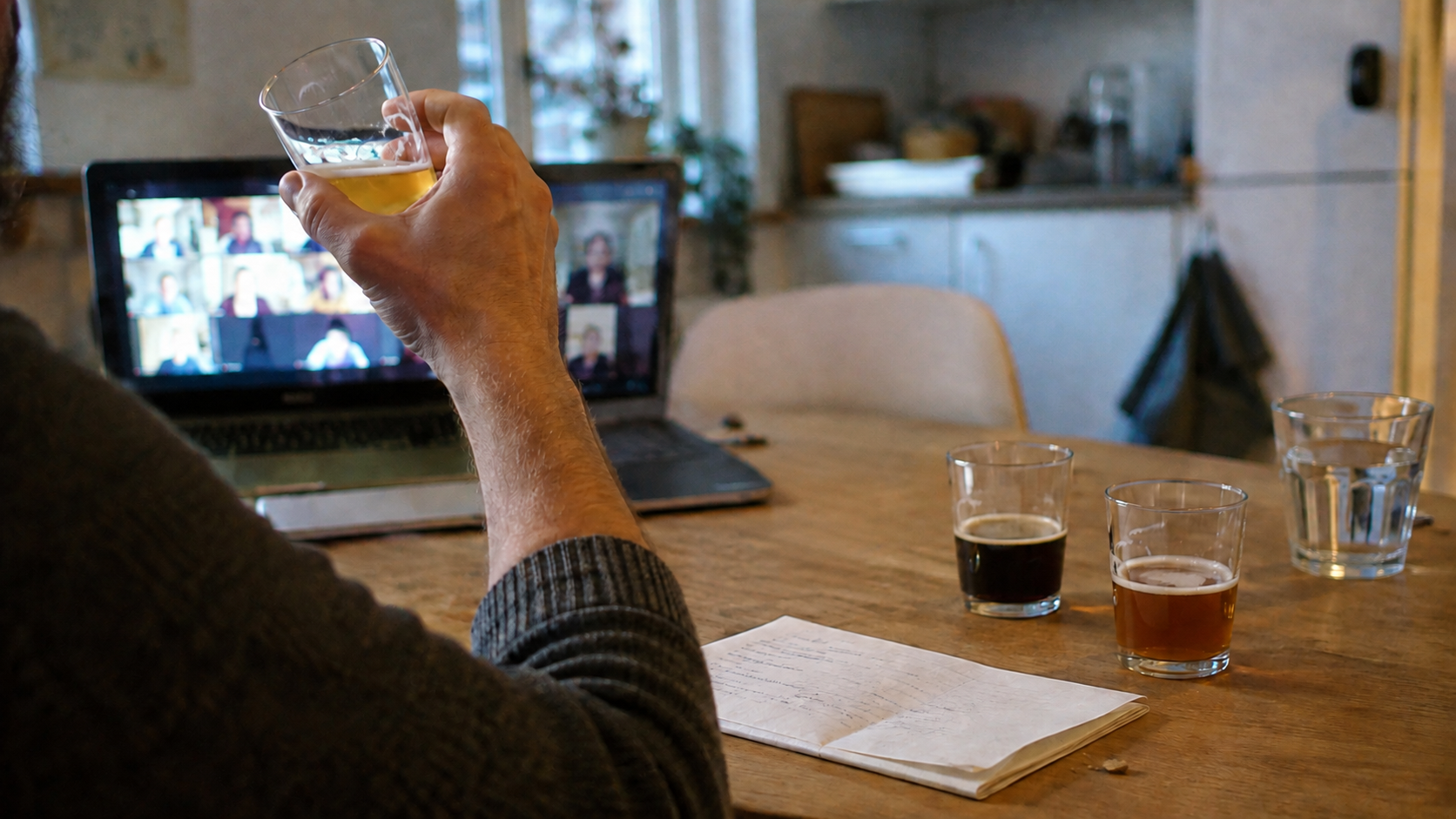
A virtual beer tasting becomes harder to host as more beers and more commentary compete for the same hour. With five or six samples, a group can spend more time waiting, warming glasses and following the host than comparing what they actually smell and taste.
Build the flight around contrast, not novelty
For a first session, choose beers that make one difference easy to notice. A pilsner, an American pale ale and a dry stout create a clear progression from crisp and restrained, through hop-led aroma, to roast. They are examples, not mandatory brands: when the same labels are unavailable in every location, match the style and approximate strength instead.
Place lower-alcohol, lighter-bodied and more delicate beers first. Put stronger, sweeter, more bitter, heavily roasted, smoked or sour beers later. The Beer Judge Certification Program uses that progression to reduce palate impact; Cicerone gives the same practical reason—alcohol, hops, roast and sweetness can tire the palate. BJCP competition guidance Cicerone serving guide
Send the final order, bottle sizes, alcohol percentages and alternatives several days before the call. Tell participants not to substitute an imperial stout for a dry stout or a double IPA for a pale ale simply because the style name looks close: strength can overwhelm the comparison.
Pour 60 ml into a glass with room above it
The BJCP competition handbook specifies a sample of about two US fluid ounces and a clear cup holding roughly seven to ten ounces, leaving room for foam, swirling and aroma. For a home tasting, that translates neatly to about 60 ml in a clean, transparent 210–300 ml tumbler, small wine glass or tulip-shaped glass. BJCP sample and glass guidance
The empty space is useful. Beer releases aroma when it is poured and gently swirled; a brim-full little cup does neither well. Cicerone also explains why tasting from the bottle or can conceals colour, foam and much of the aroma. Cicerone on using a glass
Specialized glassware is optional. Consistency is not: each participant should use the same kind of clean, odour-free glass for all three rounds, or three matching glasses if available. Rinse reusable glasses with plain water between beers and avoid perfumed detergent residue.
Pour only when a round begins. BJCP judging procedure tells judges to smell immediately after pouring and then reevaluate as the beer changes. Pre-pouring all three samples sacrifices precisely that first aromatic moment. BJCP judging procedure
Do not reduce temperature to one magic number
Cicerone’s style chart spans roughly 4.5–13°C across different beers and warns that excessive cold masks aroma while excessive warmth costs refreshment. A crisp pale beer can begin near the cool end; a stronger or malt-led beer can be allowed to warm further before it is judged. Cicerone style and serving-temperature chart
The simplest remote instruction is to refrigerate all three beers, pour them one at a time and wait if a sample seems mute. Smell it again after a few minutes in the glass. That change is part of the tasting, not a technical delay.
Give each beer 12 minutes
One hour is enough for three beers if the host protects the clock. A workable run sheet is:
- 0–5 minutes: welcome, explain the order and make clear that tasting does not mean finishing.
- 5–17 minutes: beer one.
- 17–29 minutes: beer two.
- 29–41 minutes: beer three.
- 41–55 minutes: compare the flight and revisit a sample if wanted.
- 55–60 minutes: one final observation from the group and a clean finish.
Inside each 12-minute round, keep the first minute silent. Use two minutes for appearance and aroma, two for the first sip and second smell, about four for participant observations, and the last three for the host’s style or brewery context. If discussion runs long, shorten the context rather than the observation.
Eight people is a conversation; twenty is a production
If everyone should speak during every round, cap the main group at about eight participants. Even one 30-second contribution each consumes four minutes—the discussion allowance in the schedule above. The arithmetic, not the conferencing software, sets the useful limit.
With a larger group, announce a different format before the tasting: collect short notes in chat, invite three voices per beer, or use stable breakout groups with one reporter each. Do not promise an intimate discussion to 20 people and then spend the hour calling names from a grid.
Observe first; reveal descriptors later
The host should not begin with the brewery’s tasting notes. Use the same sequence for every glass:
- Look at colour, clarity, foam and visible carbonation.
- Smell immediately after pouring, then swirl gently and smell again.
- Take a small sip and notice sweetness, bitterness, acidity, carbonation, body and finish.
- Write two or three words before hearing anybody else’s answer.
- Compare observations; only then reveal the style description or producer’s notes.
That order prevents the host’s “grapefruit,” “bread crust” or “coffee” from becoming answers participants feel expected to find. The BJCP evaluation process similarly moves through aroma, appearance, flavour, mouthfeel and reevaluation rather than beginning with a verdict. BJCP beer-evaluation process
Keep water and plain bread or unsalted crackers nearby; BJCP judging guidance uses them between samples. Save spicy, greasy or strongly flavoured food for a deliberate pairing session, and keep perfume, scented candles and cooking smells away from the table.
Decide the failure rules before the call
Remote tastings usually fail in predictable ways:
- A beer arrives missing or damaged: let that participant observe the round without forcing a random substitute, then include them first in the comparison round.
- A sample is too cold to smell: wait and return to it; do not compensate by supplying descriptors.
- One beer is obviously faulty: ask whether others detect the same thing, set it aside if its smell dominates the table and continue without making it a spectacle.
- The group is running late: drop host background and optional trivia, not the silent observation or comparison.
The invitation should also include a non-alcoholic route, and nobody should be expected to finish a sample or explain why they abstain. Three 60 ml pours put 180 ml on the table; the useful amount consumed may be less. Water is part of the setup, not an afterthought.
A successful session does not require everybody to name the same aromas. It requires enough control over the physical details that a difference in perception belongs to the beer and the people tasting it—not to a warm bottle, a perfumed glass, an overpowering first sample or a host who supplied the answer.