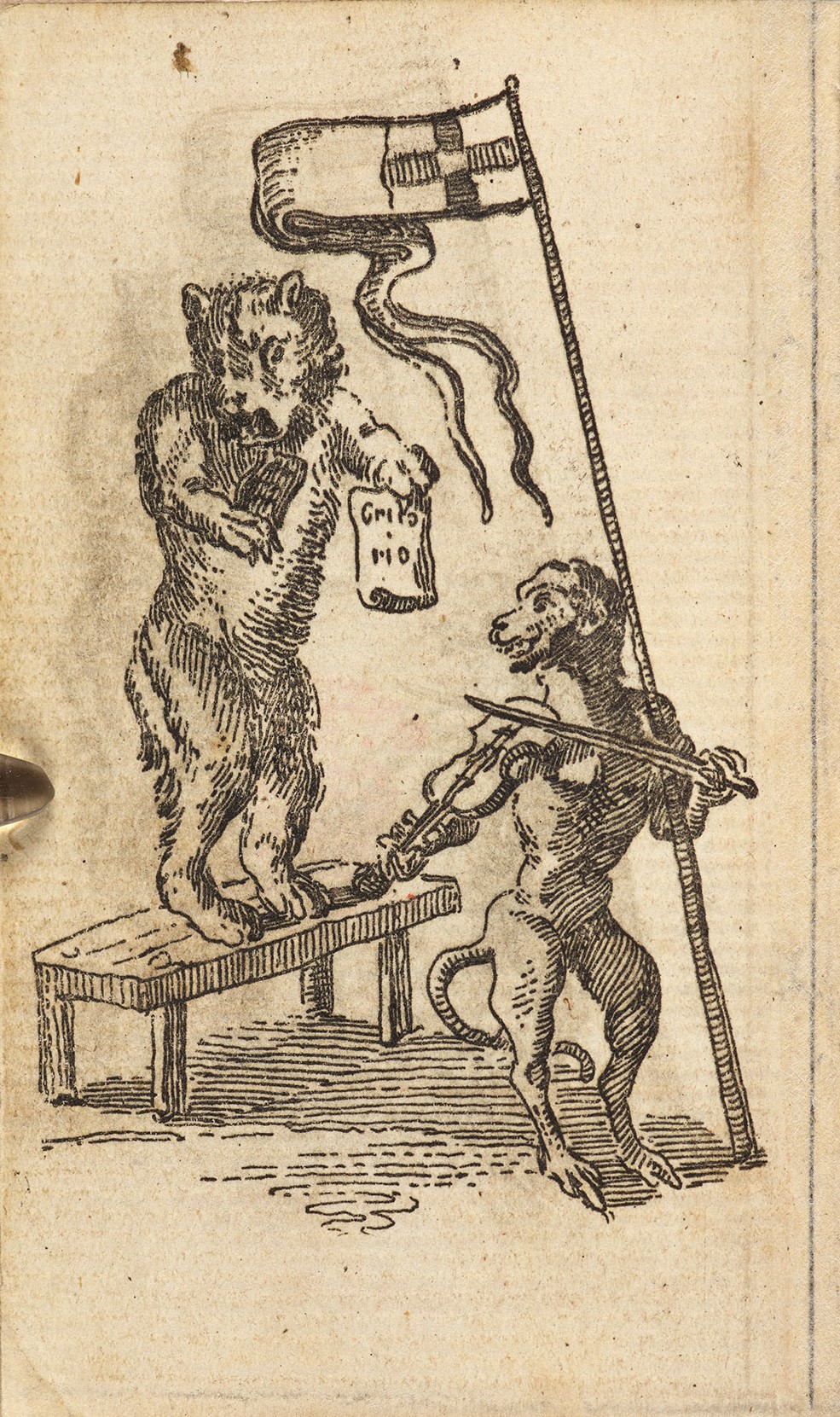
Nursery rhymes did not start in one nursery. The familiar collection grew from songs, games, riddles and short verses that people repeated, adapted and eventually printed for children. Some pieces are old enough that their makers are unknown; others have identifiable writers. The date on the oldest surviving book tells us when a version was recorded, not necessarily when somebody first sang it.
The book is a record, not a birthday
That distinction is the key to the history. A tiny London book from 1744 proves that recognizable rhymes were in circulation by then. It cannot tell us how long they had already travelled by voice. A later book marketed as Mother Goose's Melody shows publishers turning such material into a named product. Children, meanwhile, kept changing words and actions after the books appeared. The history is the movement between those settings, rather than a single moment of invention.
First, what counts as a nursery rhyme?
The label gathers several things that do different jobs. A lullaby may calm a child; a counting rhyme selects someone for a game; a finger play gives words to movement; a nonsense verse enjoys sound without promising a factual story. Some texts circulate as songs, others as spoken chants. That variety helps explain why a search for their one country or century runs into trouble. The category was assembled from practices that did not all share the same starting point.
The American Library Association describes childhood rhymes, songs and games as traditions often passed by word of mouth, with no known author in most cases. It also notes that similar forms exist across cultures without one universal set known to every child. The statement describes a way of transmission; it does not mean every rhyme lacks an author or that all cultures share the English examples. ALA childhood-folklore guide
Folklore researcher Catalina Millán Scheiding cautions that the neat collection familiar from illustrated books was once a changing body of material, shared and reshaped across languages and communities. Print preserved some forms, but it can make an evolving tradition look older and more uniform than it really was. A reader looking for origins should therefore ask which version, in which place, is being dated. Without that qualification, even a correct historical date can become a misleading answer. research article and abstract
Before the books, people carried the verses
Short, rhythmic lines are easy to remember and easy to use. A child can supply the last word, match a line to a clap, or learn a sequence by repetition. These uses help material circulate without a publisher. They also give performers a reason to change it: a different name can fit a local child, a word can suit a dialect, and a game can acquire a new action. Those are ordinary possibilities in oral tradition, not proof that any particular line changed in a particular way.
The historical difficulty is that sound leaves a thinner record than print. A surviving page establishes that the words were available to a reader at that point. It rarely identifies the first person who performed them. An early written appearance can be a record of an existing verse, a publisher's adaptation, or a newly composed piece. The page alone does not settle which. That is why a confident claim such as “this rhyme was written in 1744” needs more than a 1744 printing.
There is another complication: adults and children do not inhabit sealed cultural worlds. A short verse may be used in play after starting as a popular song, a riddle or a scrap of another performance. Conversely, a text written for children can later be treated as anonymous tradition. We need evidence for the journey of an individual rhyme before assigning it an original audience. The safest general conclusion is narrower: the printed nursery-rhyme shelf contains material with different histories.
What the 1744 Tommy Thumb book actually proves
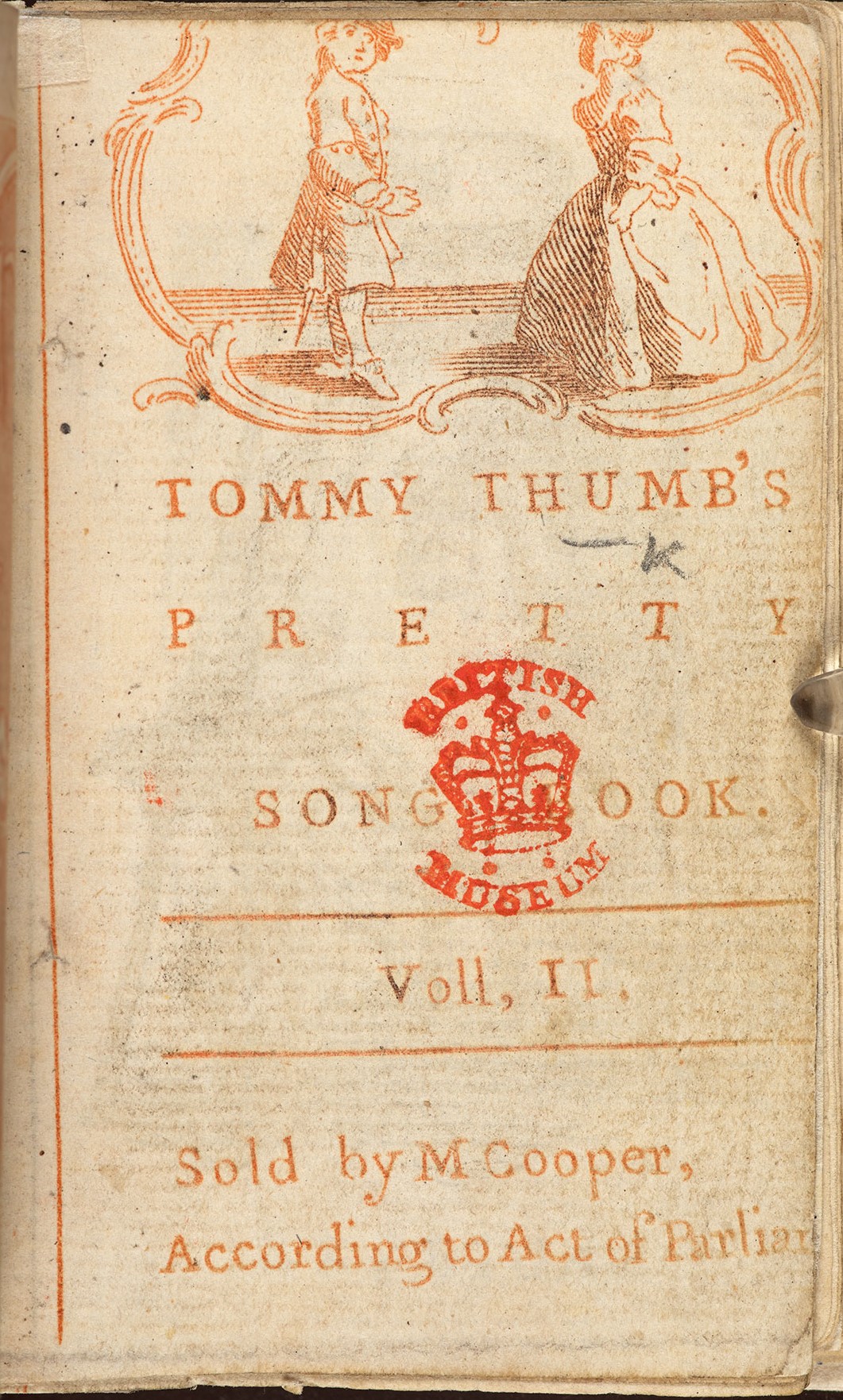
One unusually tangible milestone survives in Tommy Thumb's Pretty Song-Book, volume two. A 2016 scholarly review describes it as a 64-page miniature printed in red and black, illustrated and sold by M. Cooper in 1744. Only two copies of that volume survive, at the British Library and Princeton's Cotsen Children's Library. Advertisements indicate that volume one appeared shortly before it, but no copy of the first volume is known to survive. The Library review
The digitized title page is useful evidence in its own right. It names the book, marks it as “Vol. II” and identifies M. Cooper as its seller. Those details make this an actual publication rather than a story about an imagined medieval origin. They also show the limit of the evidence. A title page tells us how a seller presented the material, not who first invented each rhyme in it. archive scan

Some texts in the collection remain recognizable, often with different wording. The surviving book matters because it is among the earliest extant English collections of these rhymes, not because every line must have been born in London that year. It is a snapshot taken while material was moving from performance into children's print. Its missing first volume is a useful warning too: even the printed record is incomplete. “Earliest surviving” is a claim about the evidence we have, not a promise that nothing earlier ever existed.
This small physical format also changes how the story feels. We often encounter nursery rhymes as large, brightly illustrated books or videos. The 1744 object was a compact commercial book, made for handling and sale. A publisher selected and packaged verses already worth putting before readers. That was a consequential change in their circulation even if the publisher did not compose them.
Mother Goose was a name that moved between kinds of book
“Mother Goose” sounds like the name of the person who wrote the rhymes. The Library of Congress instead describes a literary and cultural storyteller figure often traced through Charles Perrault's seventeenth-century French Contes de ma Mère L'Oye, or Tales of Mother Goose. Those were associated with tales. In English, the figure became increasingly attached to children's rhymes, until “Mother Goose rhyme” and “nursery rhyme” were often used interchangeably in the United States. Library of Congress guide
The shift matters because a brand of storytelling is not a byline for hundreds of anonymous verses. A later cover saying “Mother Goose” establishes how a publisher grouped and sold material. It does not identify one grandmother who composed the collection. Nor does the French connection mean the English rhymes were all translated from French fairy tales. The figure travelled; the individual texts have to be traced separately.
Even the date of a famous English collection, Mother Goose's Melody, is less settled than a quick chronology suggests. The De Montfort University Hockliffe Project reports that 1765 or 1766 has been proposed, partly through a possible connection with Oliver Goldsmith, but the first known advertisement and Thomas Carnan's copyright registration are from 1780. The earliest surviving edition is from 1791. The project's own copy is undated and has an inscription from 1815. Hockliffe catalogue and essay
That is not a reason to erase the book from the story. It is a reason to say exactly what the record supports. “An edition survives from 1791” is firmer than “the book was invented in 1791.” “Advertised in 1780” is firmer than treating the often repeated 1765 date as a settled fact. The distinction between a proposed first edition, the earliest advertisement and the earliest surviving copy is what makes a chronology trustworthy.
Publishers changed the experience of a rhyme
The Hockliffe copy lets us see more than dates. Its pages include forms such as “Dickery, dickery, dock,” “Bah! Bah! black sheep” and “Jack and Gill went up the hill.” Those spellings and names matter: a familiar modern line is not always the only, or the earliest recorded, form. The book pairs verses with woodcuts and sometimes with small, mocking comments. One note jokes about the absurdity of a laughing dog in “Hey diddle diddle”. Hockliffe page images and essay
The comments are revealing. A printed nursery collection was not simply a parent transcribing a bedtime performance word for word. Someone arranged verses, illustrations and a knowing voice on the page. An adult reader could enjoy that voice while a child enjoyed the sound or image. The same book could thus serve more than one audience. This is an inference from the page design and commentary, not a claim to know what every eighteenth-century buyer thought.
Printing also made particular versions easier to reproduce. An illustrated book can travel beyond the household where a verse was first heard; a later publisher can copy its selection or amend it. Yet print did not stop performance. The ALA guide still describes children playing with variations of inherited songs and games. The useful historical model is a loop: people perform, books record and rearrange, and people continue performing. Treating one printed wording as the immutable original loses that loop.
Why dramatic “true meanings” rarely settle the origin
The most tempting origin stories turn an innocent-sounding line into a coded account of a plague, execution or political struggle. Some verses can carry satire or references to real life, so the idea cannot be dismissed as a category. A specific claim still needs a dated version and a credible connection to the alleged event. Similar words alone are not enough; later readers can fit a flexible line to a story it never meant to tell.
The famous plague reading of “Ring Around the Rosie” shows the problem. Library of Congress folklorist Stephen Winick reviewed early versions and the history of the explanation. He found that the plague interpretation emerged much later than the rhyme's recorded variants, and that some versions lack the words on which the theory depends. That makes the plague account an interesting later story about a rhyme, not demonstrated evidence of its creation. American Folklife Center analysis
Our separate guide to supposed hidden meanings examines more of those individual claims. For an origins question, the broader lesson is to keep three dates apart: the event a theory invokes, the earliest surviving version of the verse and the first traceable appearance of the theory. If the third is centuries later and no contemporary link bridges the gap, the dramatic interpretation has a heavy burden of proof.
A practical way to investigate one rhyme
Start by writing down the precise words you know. Then look for the oldest accessible printed or archived version and note its spelling, title, date and repository. If the version differs, preserve both texts instead of silently treating the modern one as original. A change in one crucial word can weaken an explanation built on that word. A missing verse can change what a rhyme appears to do.
Next ask what the source proves. A dated book proves publication by that date. A publisher's attribution might prove how the book marketed a text; it is not necessarily evidence of authorship. A later collector's note can show what people believed at the time of collection, but may be remote from the verse's beginning. A strong origin claim will usually have more than one kind of evidence: an early text, a traceable context and a reason to connect the two.
Finally, consider the rhyme as an action as well as a set of words. Was it a lullaby, a counting device, a circle game or a joke? A theory that explains a line of text but ignores how the verse was used may miss its most important function. This does not let us reconstruct every original performance. It gives us a better question than “Which disaster is secretly encoded here?”
The answer to where nursery rhymes came from is therefore a history of accumulation. Oral performance made short forms portable; eighteenth-century books left unusually clear snapshots; Mother Goose gave publishers and readers a durable label; and later performers kept the verses alive by changing them. For a particular rhyme, the honest answer may stop at the earliest evidence. That limit is part of the history, not a failure to find a more exciting story.
Sources
- American Library Association: childhood folklore and oral transmission
- Catalina Millán Scheiding: From nursery rhymes to childlore
- The Library: review of Tommy Thumb facsimile and history
- Wikimedia Commons: 1744 Tommy Thumb title page and rights
- Wikimedia Commons: 1744 illustrated page and rights
- Library of Congress: Finding Mother Goose
- Hockliffe Project: Mother Goose’s Melody catalogue and introductory essay
- Library of Congress: Ring Around the Rosie origin claims
