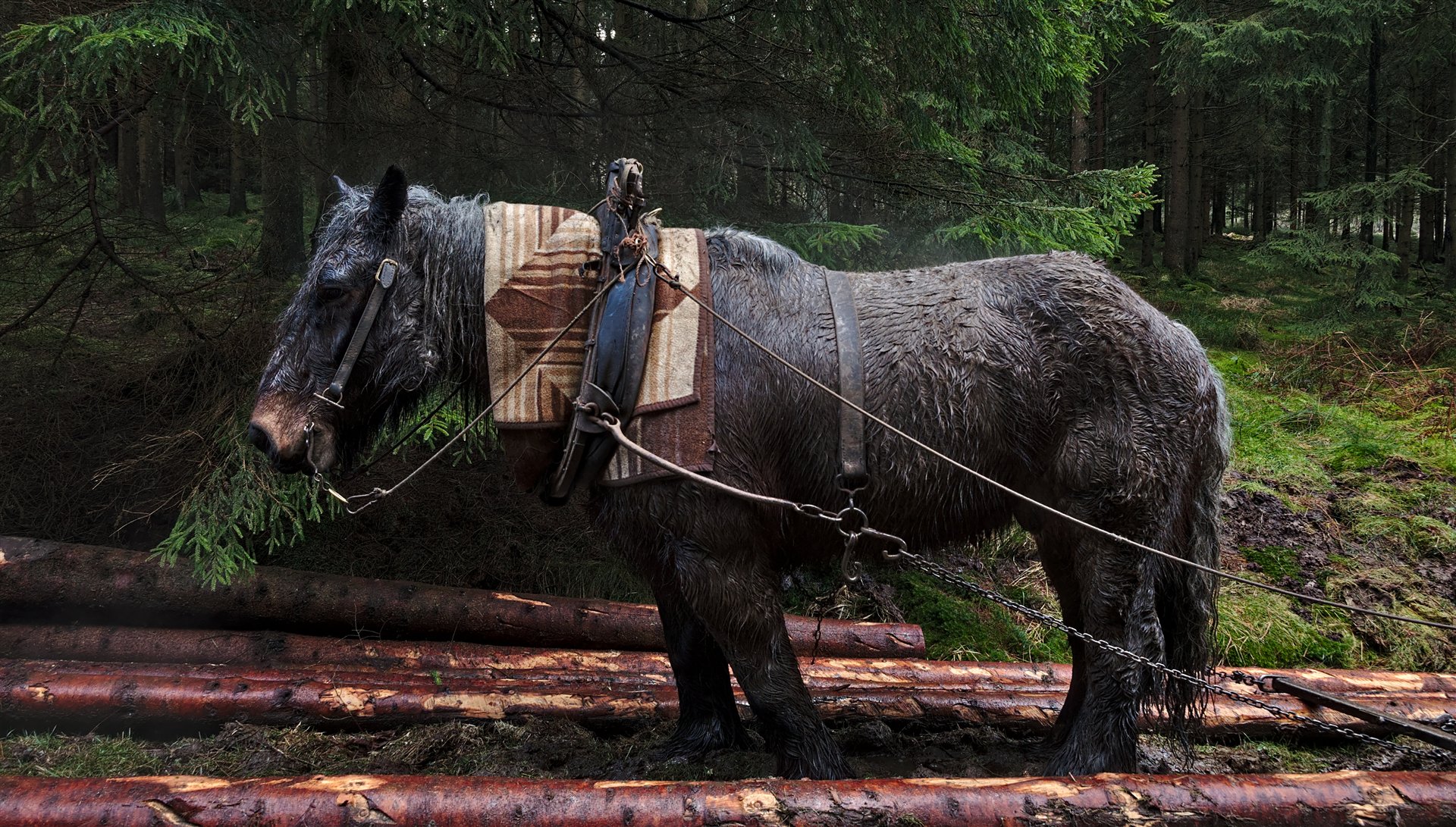
One horsepower is a fixed unit of power, not a biological rating for one horse. A horse can sustain roughly one mechanical horsepower during demanding work, yet produce several horsepower for a short effort. Historic pulling data put brief peaks at about 12 to 14.9 horsepower, while a popular modern video measured 5.7 horsepower from one horse on one improvised rig. Those figures do not contradict one another. They describe different animals, equipment, durations and ways of measuring power. The same distinction explains why a person can briefly exceed one horsepower without being able to maintain it for an hour. The useful answer is therefore not a single conversion. It is this: one mechanical horsepower equals about 746 watts, while the output of a real horse changes from moment to moment.
Horsepower measures a rate, not a head count
Power tells you how quickly work is done. In a straight pull, it depends on both the force applied and the speed at which the load moves. A strong animal that holds a load still is exerting force, but the mechanical power delivered to the load is zero because nothing is moving. The same animal produces more power when it moves the load faster.
The traditional mechanical horsepower used in the United States and Britain is defined as 550 foot-pounds per second, or 33,000 foot-pounds per minute. That is about 745.7 watts, conventionally rounded to 746 watts. It is a defined engineering unit, so it does not change with the breed, age or mood of the horse. US Bureau of Standards history and definition
There is also a metric horsepower, often written as PS, CV or hk depending on the language and market. It is about 735.5 watts. That makes it roughly 1.4 percent smaller than mechanical horsepower. The distinction is usually minor in casual conversation, but it matters when comparing specifications from different countries.
| Quantity | Approximate power | What it describes |
|---|---|---|
| 1 mechanical horsepower | 746 watts | A fixed English and American engineering unit |
| 1 metric horsepower | 736 watts | A slightly smaller unit used in some vehicle markets |
| 5.7 mechanical horsepower | 4.25 kilowatts | The reported peak from one horse in the Donut video test |
| 12 to 14.9 mechanical horsepower | 8.9 to 11.1 kilowatts | Brief peaks reported from historic pulling-contest data |
Why James Watt chose the number
The name is a piece of industrial marketing that became a measurement standard. James Watt wanted customers familiar with working horses to understand what his steam engines could replace.
A historic United States Bureau of Standards review traces the familiar calculation to observations associated with Watt and Matthew Boulton at the Barclay and Perkins brewery around 1775. A horse was estimated to raise a 100-pound load while walking at about 2.5 miles per hour, which produced a work rate of 22,000 foot-pounds per minute. Watt added 50 percent, partly to allow for friction and partly to avoid disappointing purchasers. The result was 33,000 foot-pounds per minute. Bureau of Standards Circular 34
That history is sometimes flattened into the claim that Watt deliberately lied about horses. The contemporary engineering logic was more practical. He was defining a conservative commercial comparison for sustained machinery, not trying to record the highest possible burst from an animal.
The same Bureau of Standards paper noted that the unit was above the continuous output of an average horse and probably at least twice the average output of a horse working a six-hour day. In other words, the name never meant that every horse continuously produces exactly one horsepower.
A horse can produce far more than one horsepower for a few seconds
Muscle can deliver intense power briefly and much less power over a long period. That is true of horses, humans and engines, although the limits arise for different reasons.
In a 1993 scientific correspondence in Nature, Robert Stevenson and Richard Wassersug examined the apparent mismatch between a horse and the unit named after it. They cited data from a 1925 pulling contest at the Iowa State Fair in which horses briefly produced between 12 and 14.9 horsepower. They also built a theoretical estimate around the muscle mass of a 600-kilogram horse. The upper calculation reached roughly 24 horsepower, but the authors warned that its assumptions could overstate the result by a factor of two. Their more defensible conclusion was that a short peak around 12 horsepower was plausible. Stevenson and Wassersug, Horsepower from a horse
The paper did not establish one universal maximum. It was a short scientific argument drawing on earlier records and physiological assumptions, not a modern controlled trial across breeds. Its enduring value is the distinction it makes: Watt's unit reflected useful daily work, while a measured peak lasts only seconds.
Breed and body build also matter. Research comparing Thoroughbreds and draft horses shows different force-speed characteristics. A draft horse is selected for high pulling force; a Thoroughbred is selected for speed. Power combines force and speed, so neither body type can be represented by a single number that applies to all horses. Journal of Applied Physiology horse comparison
Training, footing, harness fit, motivation, health and the mass of horse and load add more variation. Asking how much horsepower a horse has without specifying the test is like asking how fast a vehicle is without saying whether the question concerns acceleration, top speed or an hour-long endurance run.
What the 5.7-horsepower video actually measured
The Donut video tried to put one horse on an improvised dynamometer. The team connected a light draft horse called Big D to a rig built from a Honda Civic drivetrain and an inertial automotive dyno. After several short pulls, the presenters reported a best result of 5.7 horsepower after applying their estimate of drivetrain losses. Watch the Donut experiment
That is about 4.25 kilowatts. It is a believable short-duration result for that animal in that setup, and the experiment makes the central idea unusually visible: a horse can exceed the unit named after it.
It does not show that every horse equals 5.7 horsepower. It tested one horse, on one day, using equipment designed around rotating vehicle components rather than direct animal-power measurement. The horse had to accelerate a drivetrain before the dyno estimated power. Bearings, gears, shafts and tyres absorb energy, so the correction for mechanical losses matters. A different estimate could change the reported number.
The video team also prioritised the animal's safety and stopped rather than forcing an unwilling or distressed performance. That was the right boundary. It means the result should be read as an engaging demonstration, not a search for the animal's physiological breaking point.
Viewers asked the questions that make the result useful
The public comments beneath the video repeatedly focused on four issues. The comments are not scientific evidence, but the questions identify what a careful explanation must answer.
First, viewers asked about sustained power. A short dyno pull measures a burst. It cannot tell us what the horse could deliver for an hour, a working day or repeated sessions. A treadmill or drawbar study with controlled duration would answer a different question.
Second, viewers questioned the sample. One light draft horse cannot represent ponies, heavy draft breeds, racehorses and trained pulling animals. A useful comparison would test several animals and report their mass, breed, conditioning and experience.
Third, viewers noticed drivetrain losses. The machine measured power after the horse's pull had passed through a mechanical system. That is similar to the difference between engine horsepower measured at a crankshaft and wheel horsepower measured after a vehicle's transmission. Both can be valid, but they answer different questions and should not share a label without explanation.
Fourth, several people suggested measuring force and speed directly. That is the cleanest general method. A calibrated load cell or strain gauge can measure the pull at the harness or drawbar, while a synchronized speed sensor measures how quickly the attachment moves. Multiplying force by speed gives instantaneous power at that point. The system can then calculate a peak, a short average and a sustained average without guessing as much about drivetrain loss.
These are not pedantic objections. They determine whether a result describes the animal, the complete horse-and-machine system or only the output that reached the final measuring device.
How a stronger horse-power test would work
A scientifically useful test would begin by defining the question. If the goal is maximum burst power, the load and distance should be designed for a short, safe pull. If the goal is useful farm work, the protocol should measure a lower output for much longer and include rest periods.
The equipment should record force and speed at the same instant. Multiplying the two values produces a time series of power rather than one unexplained headline number. Researchers could then report:
- Peak power over a clearly defined fraction of a second.
- Average power over the complete pull.
- Sustained power over a specified working period.
- The output at the harness and, if machinery is involved, the output after mechanical losses.
- The animal's mass, breed, age, training and relevant health information.
- Surface, slope, temperature and harness conditions.
- The number of trials and the variation between them.
Testing multiple horses would show a range instead of pretending that the species has one rating. Repeating trials could separate a real pattern from a fortunate start or an equipment anomaly. Independent calibration with a known force or a motor of known output would also test whether the rig reports sensible values.
Animal welfare has to limit the protocol. Maximum effort is not automatically the most informative measurement, and it does not justify exhaustion, pain or avoidable risk. A study should have competent handlers, veterinary oversight appropriate to the procedure, safe footing, a well-fitted harness and clear stopping rules.
Why cars still use horsepower
Horsepower survived because it gives people a familiar scale and because vehicle industries built decades of specifications around it. The unit now has a precise definition independent of horses. A 200-horsepower engine is rated at roughly 149 kilowatts whether any animal could match it or not.
The number can still conceal measurement differences. Manufacturers usually quote power at the engine under a standardized test, while a chassis dyno measures what reaches the driven wheels. Transmission, tyres and other components reduce the figure at the wheels. That is why two honest horsepower values for the same vehicle may differ.
Power also does not describe the whole driving experience. Torque is rotational force, while power includes how quickly that torque is delivered. The Articleous guide to horsepower versus torque explains why an engine with strong low-speed torque can feel forceful even when another engine has a higher peak-power number. Read horsepower versus torque
Kilowatts are easier to compare scientifically because they belong to the International System of Units and avoid the mechanical-versus-metric horsepower ambiguity. Still, horsepower remains useful if the standard and measurement point are stated.
The bottom line
One mechanical horsepower is about 746 watts. That number is fixed. A horse's output is not.
For sustained demanding work, roughly one horsepower is a reasonable order-of-magnitude estimate for a horse. During a short pull, a horse can produce several times that amount. Historic contest data support brief peaks around 12 to 14.9 horsepower, while the modern video rig reported 5.7 horsepower from one horse under its particular conditions.
The apparent paradox disappears once duration and measurement are included. Horsepower was designed as a conservative comparison for useful work. It was never intended as the maximum biological rating of every horse.
Sources
- US Bureau of Standards: Horsepower and Its Relation to Other Units
- Stevenson and Wassersug: Horsepower from a horse
- Journal of Applied Physiology: Force, speed, and oxygen consumption in Thoroughbred and draft horses
- Donut: How Much Horsepower is a Horse?
- Wikimedia Commons image and CC BY 4.0 licence record
.jpg)