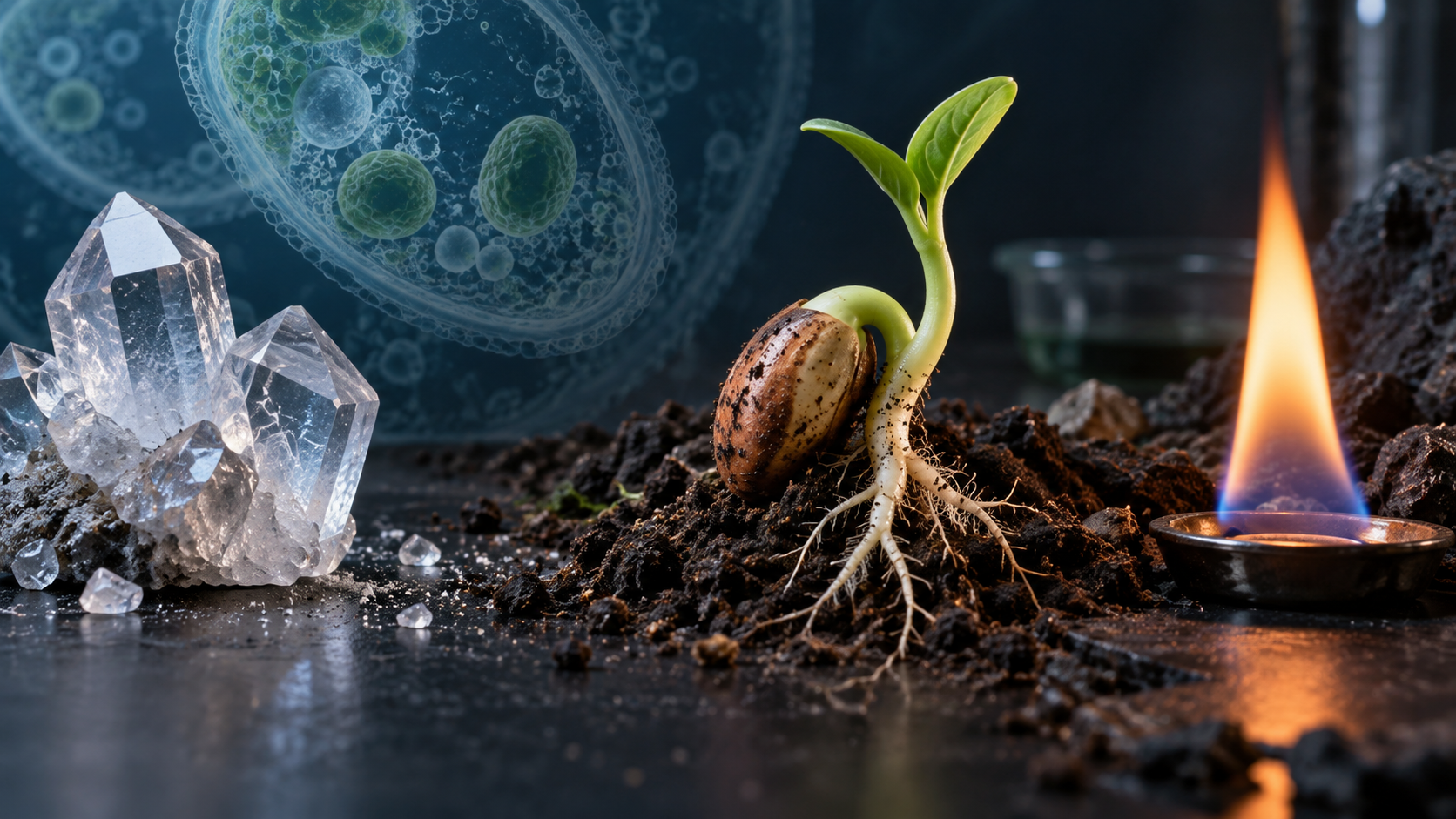
A flame grows, consumes fuel and spreads. A crystal grows. A robot senses its surroundings. None is automatically alive. The schoolroom question “living or non-living?” becomes difficult when one dramatic feature is treated as a definition. Biology instead uses a cluster of properties—and still leaves border cases such as viruses open to debate.
Life is recognised by a bundle of properties
Introductory biology commonly describes living systems through organisation, response to stimuli, reproduction, adaptation, growth and development, regulation, homeostasis, energy processing and evolution. OpenStax presents these as connected themes rather than a magic checklist in which every organism must visibly perform every item at every moment. OpenStax Biology: themes and concepts
Living things are made of one or more cells, the basic units that maintain a controlled internal environment and carry genetic information. They obtain or transform energy and matter, regulate conditions within workable limits and respond to their surroundings. Populations reproduce with heritable variation, allowing evolution by natural selection across generations.
No single property settles the matter. A mule may be sterile but is alive because it is an organised organism produced by, and participating in, a living evolutionary lineage. A dormant seed may show almost no visible activity but retains a viable embryo and cellular machinery. Classification considers the system and its history, not just what it does during a five-minute observation.
Why movement and growth produce false positives
A cloud moves because air currents and pressure differences carry droplets. A river changes course under gravity and erosion. A crystal enlarges when dissolved particles attach in an ordered pattern. Fire spreads when heat starts new combustion in nearby fuel. These processes can be complex and responsive to conditions without having cells, inherited biological information or self-maintaining metabolism.
Growth also means different things. An organism grows by controlled cellular processes, using genetic instructions and energy to make and organise material. A crystal grows by adding external units to its surface. A snowball grows as more snow sticks. The visible outcome—something becomes larger—does not reveal the mechanism.
The same caution applies to apparent purpose. Sunflowers turn as growth and cell pressure respond to light; a thermostat activates because humans designed a control system. Both can be described as responses, but only the plant belongs to a cellular, metabolising, evolving lineage. Language such as “wants,” “knows” or “tries” can be convenient without being literal evidence of life.
Seeds are alive while dormant
A dry viable seed contains an embryo, stored resources and protective tissues. Its metabolism can be extremely low, which helps it survive unfavourable conditions. When water, oxygen and temperature become suitable, metabolic pathways resume, the embryo grows and the root emerges. Dormancy is not the absence of life; it is a regulated state in a living life cycle.
Not every seed in a packet remains alive. Age, heat, moisture, fungi or physical damage can destroy viability even when the shell looks intact. That is why germination tests use a sample under controlled conditions. Failure to germinate does not prove that seeds as a category are non-living; it may identify a dead seed or unsuitable conditions.
This distinction is useful beyond homework. A dry bean intended for food may contain an embryo but may no longer be viable after processing. A seed in deep dormancy can be living even though it does not germinate immediately. The accurate answer depends on whether the question is about the object’s structure, its present viability or its role in the plant life cycle.
An egg contains living material, but the question is ambiguous
An unfertilised bird egg contains cells and biological material produced by a living animal, but it does not contain a developing bird embryo. A fertilised, viable egg can contain a living embryo whose development continues when temperature, humidity and gas exchange are suitable. A fertilised egg that has died is no longer a living organism even though much of its material remains organic.
So “Is an egg alive?” needs clarification. Are we asking whether any cells in a fresh egg are living, whether an embryo is present, whether that embryo remains viable, or whether the egg as a whole is an independent organism? Those are different biological claims. A kitchen egg cannot be classified reliably from shell colour or supermarket label alone.
The same problem occurs with wood, hair and fruit. A wooden chair came from a living tree but is not alive. A cut branch may retain living cells for a time and can sometimes root. Hair outside the follicle is keratinised material rather than living tissue. Fruit may contain living seeds and metabolically active tissues after harvest without functioning as an independent plant.
Viruses sit at the most famous boundary
Viruses carry genetic information and evolve, but they do not have cellular machinery that independently produces energy or proteins. They must enter a host cell and use its molecular systems to make new virus particles. OpenStax therefore describes the question of whether viruses are alive as an enduring debate rather than a fact settled by one feature. OpenStax Biology 2e: introduction to viruses
Outside a host, a virus particle can be chemically stable and inert. Inside a suitable cell, viral genes redirect an active biological system. Some definitions exclude viruses because they are not cellular and cannot reproduce or maintain themselves independently. Other researchers emphasise their genetic continuity and evolutionary role.
Calling viruses a border case is not evasion. It shows what a definition is for. A clinical virologist, an evolutionary biologist and an astrobiologist may need different operational boundaries while still agreeing on the observations. The evidence—genome, host dependence, replication and evolution—is more important than pretending the label has no contested edge.
Astrobiology needs a definition that can travel
NASA astrobiology materials often use a working definition of life as a “self-sustaining chemical system capable of Darwinian evolution.” The wording is deliberately practical: a mission looking for life beyond Earth cannot rely only on familiar shapes, oxygen use or Earth species. It must look for chemistry and organisation that maintain and reproduce an evolving system. NASA Astrobiology: alive or not
The definition also exposes hard questions. An individual animal cannot remain self-sustaining forever and depends on an ecosystem. A sterile worker ant cannot reproduce alone. A virus evolves but borrows the host’s machinery. A hypothetical alien system might use unfamiliar chemistry. Scientists therefore combine definitions with measurable biosignatures and alternative explanations.
When evaluating a possible sign of life, ask whether non-living chemistry or geology could produce it. Methane, complex organic molecules or a repeating pattern can be exciting without being proof. Strong evidence comes from multiple observations that fit a biological system better than abiotic processes and survive attempts to explain them another way.
AI and robots can imitate some signs without being biological life
A robot can move toward a charger, regulate temperature and respond to sensors. Software can adapt its outputs and an AI system can generate language about its own state. Those functions are real, but current machines are manufactured systems that depend on human-built hardware, energy infrastructure and training or programming. They are not cellular chemical organisms descended through biological reproduction.
That does not settle every philosophical question about consciousness, moral status or future artificial life. It does settle a narrower classroom classification: behaving intelligently is not one of biology’s sufficient criteria for being alive. Conversely, bacteria are alive without language, a nervous system or reflective awareness.
If engineers eventually create systems that manufacture themselves, maintain their own boundaries and undergo open-ended heritable evolution, biology and artificial-life research may need sharper categories. The honest answer would come from what those systems actually do, not from a marketing label or the fact that they resemble people in conversation.
A better way to answer the classroom question
First identify the unit: one cell, an organism, a seed, a population or material that came from an organism. Second ask how it is organised, obtains energy, regulates itself, responds and participates in reproduction and evolution. Third test whether the same visible behaviour has a simpler non-living mechanism.
Then state uncertainty precisely. “A viable dormant seed is alive even though activity is hard to observe.” “A fertilised egg may contain a living embryo; an unfertilised egg does not.” “A flame spreads and consumes fuel but lacks cells, heredity and biological evolution.” “Viruses evolve but depend on host cells, so their status depends on the operational definition.”
The aim is not to memorise eight boxes and force every object through them. It is to explain the mechanism and compare it with a coherent model of living systems. That method produces fewer confident mistakes—and a more interesting answer than deciding that anything that moves must be alive.
