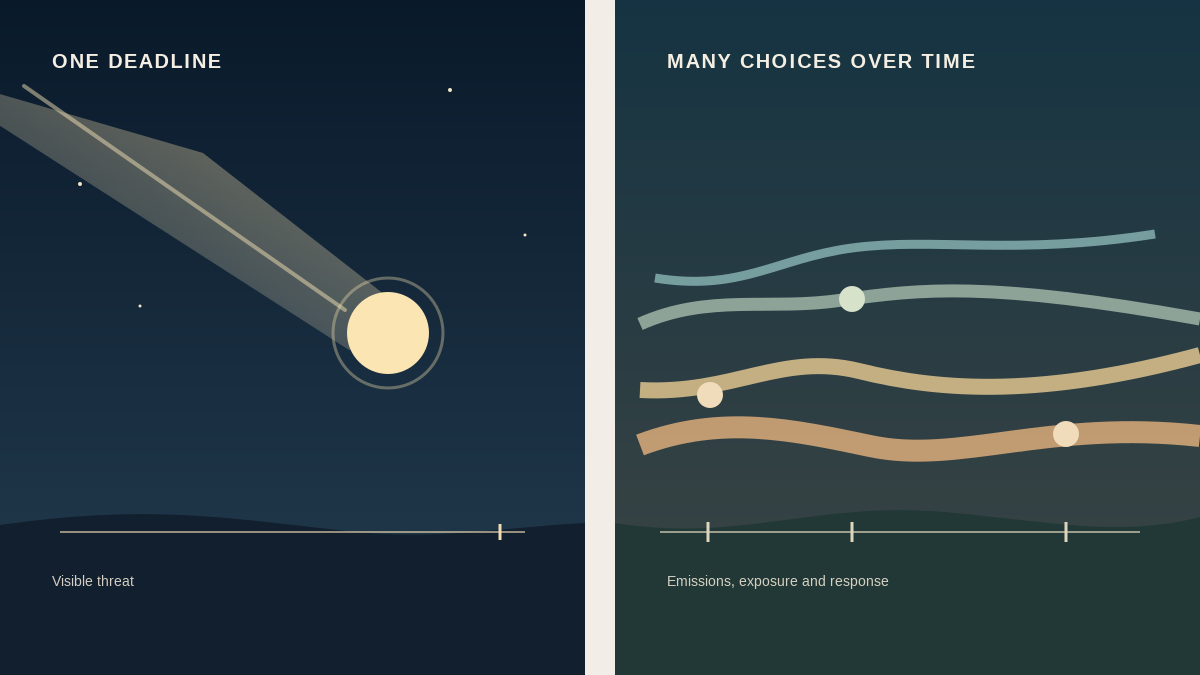
Don't Look Up makes one thing impossible to miss: a comet heads for Earth while political, media and business leaders delay. The device is powerful as satire. It also turns climate change into a single visible object, a known deadline and an all-or-nothing outcome. Real climate risk accumulates through emissions, falls unequally and remains responsive to mitigation and adaptation choices. When the comet becomes a model of that crisis, urgency can harden into a false binary: save everything now or lose everything. That is the central weakness of the analogy. The film's craft and its effect on viewers raise separate questions.
The comet makes one part of the problem impossible to miss
In Netflix's official synopsis, two astronomers discover a comet headed for Earth and spend six months trying to make politicians, journalists and the public take the warning seriously. The story removes a difficulty that runs through real climate reporting: nobody has to explain why a warming average matters, or how an invisible gas can change the probability of a damaging event. A large approaching object supplies the plot with a single cause, a visible trajectory and a final day. Source: Netflix's official synopsis
That simplification is deliberate. Adam McKay and the cast discussed the climate connection when the film was released. McKay made a comedy in which the warning is clear but the response is repeatedly delayed, repackaged or turned into entertainment. The viewer can see the absurdity without first reading a scientific assessment. As an exercise in dramatizing distraction and motivated delay, a comet is remarkably efficient. Source: Adam McKay and the cast discussed the climate connection
The gain comes with a cost. In the film, the decisive scientific claim is a binary one: either the comet hits or it does not. Once a sufficiently large comet is close enough, the question of whether to act should look uncomplicated, even if the action is hard. Climate policy presents many choices before and after each threshold of warming. A community can reduce emissions, adapt to heat or floods, protect vulnerable people and change infrastructure at different speeds. The story's all-or-nothing deadline makes that continuing work harder to picture.
Real climate risk is cumulative, unequal and still changeable
The IPCC's 2023 synthesis says human activities, mainly greenhouse gas emissions, unequivocally caused global warming. Its estimate for 2011 to 2020 is about 1.1 degrees Celsius above the 1850 to 1900 average. That dated comparison describes a measured historical period, not a current thermometer reading. The report also explains that future warming depends heavily on cumulative carbon dioxide emissions. Every further increment raises risks; reducing emissions changes the amount of future warming. Source: IPCC's 2023 synthesis
There is no single day on which the world goes from safe to destroyed. The IPCC describes rising risks, some irreversible losses and limits to adaptation, alongside pathways that can still reduce harm. Treating a missed target as permission to give up would mistake a planning threshold for a movie ending. Treating all possible outcomes as equally bad would also erase the value of cutting emissions earlier and preparing for impacts already underway. The physical system has momentum, but the human response has degrees.
Nor does every person face the same threat at the same time. The IPCC's assessment of impacts and vulnerability estimates that roughly 3.3 to 3.6 billion people live in contexts highly vulnerable to climate change. It reports that, during 2010 to 2020, human mortality from floods, droughts and storms was 15 times higher in highly vulnerable regions than in regions with very low vulnerability. These are assessed regional patterns, not a prediction that each event has a single climate cause. They show why one planet-wide projectile is a poor map of who is harmed first, who has resources to adapt and who contributed most to the problem. Source: IPCC's assessment of impacts and vulnerability
A useful comparison is therefore narrow. The comet helps explain how institutions can receive a serious scientific warning and still fail to respond. It does not explain the accumulation of emissions, the distribution of harm or the fact that partial action still matters. If a viewer carries the film's urgency into a discussion of climate policy, those missing pieces have to be supplied from elsewhere.
The case against the film is about its craft
The strongest point in Ammar Hejazi's March 2026 video critique comes early. He describes a president, television hosts, a technology billionaire and scientists who often function as signs for an argument rather than people with complicated motives. Satire can make such figures broad on purpose. A feature film still has to decide how long a single kind of exaggeration can hold attention. Hejazi says the film returns so often to the media's frivolity that the joke stops developing. That is a concrete complaint about repetition, pacing and character, even for a viewer who agrees with the warning. Source: Ammar Hejazi's March 2026 video critique
His complaint about the celebrity cast belongs in the same discussion. A famous actor can attract an audience and make a role memorable; a famous actor cannot give a character more than the script allows. The two astronomers are not identical. Randall Mindy tries to work within television's rules, while Kate Dibiasky resists its demand for reassuring performance. Science-communication scholar Declan Fahy points out that difference when examining the film's media scenes. It gives the central pair some texture. It does less to answer Hejazi's complaint about the many supporting figures who exist mainly to embody a bad incentive. Source: Science-communication scholar Declan Fahy points out that difference
Then there is the ending. Hejazi says a relentless tone of outrage leaves him numb by the time the comet strikes. Other viewers may find the final family meal moving precisely because the noise stops and the characters have a short, ordinary moment together. Neither reaction can be declared universal by inspecting the film or a transcript. The editorial point is narrower: a story that spends much of its running time increasing volume may give its quiet final scene more force for some viewers and less for others. Whether the jokes land is a film question. Whether the film changes climate attitudes requires evidence of a different kind. Source: final family meal
The film's villains are also institutions
Hejazi's more sweeping claim is that the film scolds viewers instead of challenging power. It certainly ridicules ordinary people, but the president and technology executive are hardly powerless targets. The president protects her political position, the media programme sells attention and comfort, and the executive turns an extinction threat into a commercial opportunity. Saying the film never confronts power misses those choices. The harder objection is that a handful of cartoonish leaders can make institutional failure look like a personality problem, while the audience is asked to laugh at everyone else too.
In a Journal of Science Communication analysis, Julie Doyle reads the film as a critique of speculative technological fixes, extractive capitalism and celebrity culture. That is an interpretation of the film, not proof that every viewer understands it that way. It does, however, answer the claim that McKay shows nothing beyond individual stupidity. The film puts political, media and business incentives on screen, even if it expresses them through exaggerated personalities. Source: Journal of Science Communication analysis
Its institutional critique is incomplete for another reason. A climate response is not a single heroic mission that governments merely need to authorize. The IPCC describes mitigation pathways involving changes in energy supply, efficiency, demand, land use and other sectors, with differing costs and benefits. Adaptation adds another set of decisions. Who pays, who is protected, who can object and how success is measured are political questions that cannot fit neatly into a race to divert one comet. Mocking the obstruction is easier than showing the negotiations that might replace it. Source: IPCC describes mitigation pathways
Fahy identifies a second limit in the media caricature. His JCOM analysis of the film's news scenes argues that the film exaggerates journalism's failures while leaving out the decades of climate reporting that brought the issue to public attention. The film has a reason to focus on the worst possible television response, but a viewer could leave with too simple an account of what journalists have and have not done. Hejazi's complaint that the same media joke keeps returning is a matter of rhythm; Fahy's objection concerns the picture of journalism that repetition leaves behind. Source: JCOM analysis of the film's news scenes
That limitation need not make the satire worthless. A fictional story can isolate one failure mode and make it memorable. The mistake would be asking it to perform the work of a climate assessment, a policy comparison and a local adaptation plan at once. The audience should be able to say both that the film catches a real pattern of avoidance and that its physical metaphor conceals much of the actual problem.
Who is the joke for?
Hejazi's charge that the film talks down to viewers is also the point at which a personal review meets a wider communication question. The film laughs at powerful figures, but it laughs at ordinary citizens, media consumers and scientists as well. In a Journal of Science Communication commentary, Hannah Little argues that ridicule can create an inside group that recognizes the joke and an outside group that feels targeted or excluded. She also notes that the film never explicitly says "climate change," so viewers need enough prior context to make the intended connection. Her argument identifies a plausible risk; it is not a measurement showing that a particular audience actually turned away. Source: Journal of Science Communication commentary
The opposite response is plausible too. A person already frustrated by years of evasive coverage may find relief in a story that stops pretending the problem is minor. The same scene could reassure one viewer that others share the concern and make another feel spoken down to. A claim that the film simply persuades or simply alienates "the public" assumes one audience with one starting point. The empirical work is more cautious.
What an audience experiment actually found
In a 2024 report by Rare's Center for Behavior and the Environment, researchers randomly assigned 1,402 participants from ten countries to one of three conditions. One group of 459 watched Don't Look Up alone; 463 watched it followed by a short Leonardo DiCaprio campaign video explaining the climate connection; 480 watched a non-climate control film. Surveys before and after viewing measured attitudes and stated intentions. That design gives the study a stronger basis for short-term causal claims than simply asking fans how they felt after seeing the movie. Source: 2024 report by Rare's Center for Behavior and the Environment
The film alone produced a mixed pattern. The film plus campaign video more consistently increased perceived threat, worry, stated likelihood of action and support for government action, compared with the control films. Rare's summary reports a 10.5-point increase in perceived threat and an 8.9-point increase in worry on 100-point scales for the combined condition. Those figures are changes in survey responses under the study's conditions, not percentages of viewers who acted, and they should not be assigned to the film alone.
On other measures, the result was quieter. The researchers reported no reliable improvement in beliefs about how much action other people were taking, personal ability to make a difference or confidence in institutions' ability to address climate change. They also found no reliable improvement in the belief that public pressure can make organizations act. Raising a sense of threat is not the same thing as raising a sense of agency. This is a particularly important gap for a story whose ending offers no model of a successful collective response.
Rare also surveyed 1,881 people about whether they had watched the film in ordinary life and used those data to reweight the experimental results toward natural viewers. Its estimates for those viewers were generally smaller, and many effects were not statistically distinguishable from zero. This adjustment is useful, but it cannot turn a short viewing experiment into evidence that the film changed voting, energy use or government policy years later. The study measured mental states and stated intentions shortly after exposure, not durable behavior.
A separate 2025 Politics & Policy survey of 2,045 Americans found stronger proenvironmental attitudes among viewers who said they were deeply absorbed in the film, including both Democratic and Republican respondents. That is an association. People already concerned about climate change may have been more likely to watch, engage deeply or remember the film. The survey is informative about who connected with the story; it does not independently prove that the film changed their minds. Source: 2025 Politics & Policy survey
The better question after the credits
The fundamental problem is the comet's binary grammar. It makes avoidable catastrophe visible while squeezing out the continuing politics of emissions, adaptation, equity and partial harm reduction. The film can help a viewer recognize delay, but using it as a full climate map would mislead. Hejazi's video raises a separate, substantial objection: thin supporting characters, recurring media jokes and sustained scolding can weaken the delivery. His broader claim that the satire does not challenge power at all goes too far. The film repeatedly places political, media and commercial incentives in the path of the warning.
That leaves a practical way to watch it. When the film shows a warning being trivialized, ask which attention or financial incentive rewards that response in real institutions. When it shows a single countdown, replace that image with the IPCC's account of accumulating emissions and rising risks. When the story ends in catastrophe, remember that real climate outcomes are not all-or-nothing. Lower emissions and better adaptation can still alter future harm, including for people who are already most exposed.
The audience evidence answers another question. Rare's experiment suggests the film can intensify concern, especially when a separate message names the climate connection. It gives much less support to the idea that the film alone builds confidence in a workable response. That finding cannot tell us whether its jokes work, and it cannot turn the comet into a faithful physical analogy. The image is an alarm about avoidance. After the credits, the useful correction is that there is no single impact day and no point at which reducing future harm stops mattering.
Sources
- Netflix's official synopsis
- Adam McKay and the cast discussed the climate connection
- IPCC describes mitigation pathways
- IPCC's assessment of impacts and vulnerability
- Ammar Hejazi's March 2026 video critique
- JCOM analysis of the film's news scenes
- Journal of Science Communication analysis
- Journal of Science Communication commentary
- 2024 report by Rare's Center for Behavior and the Environment
- 2025 Politics & Policy survey