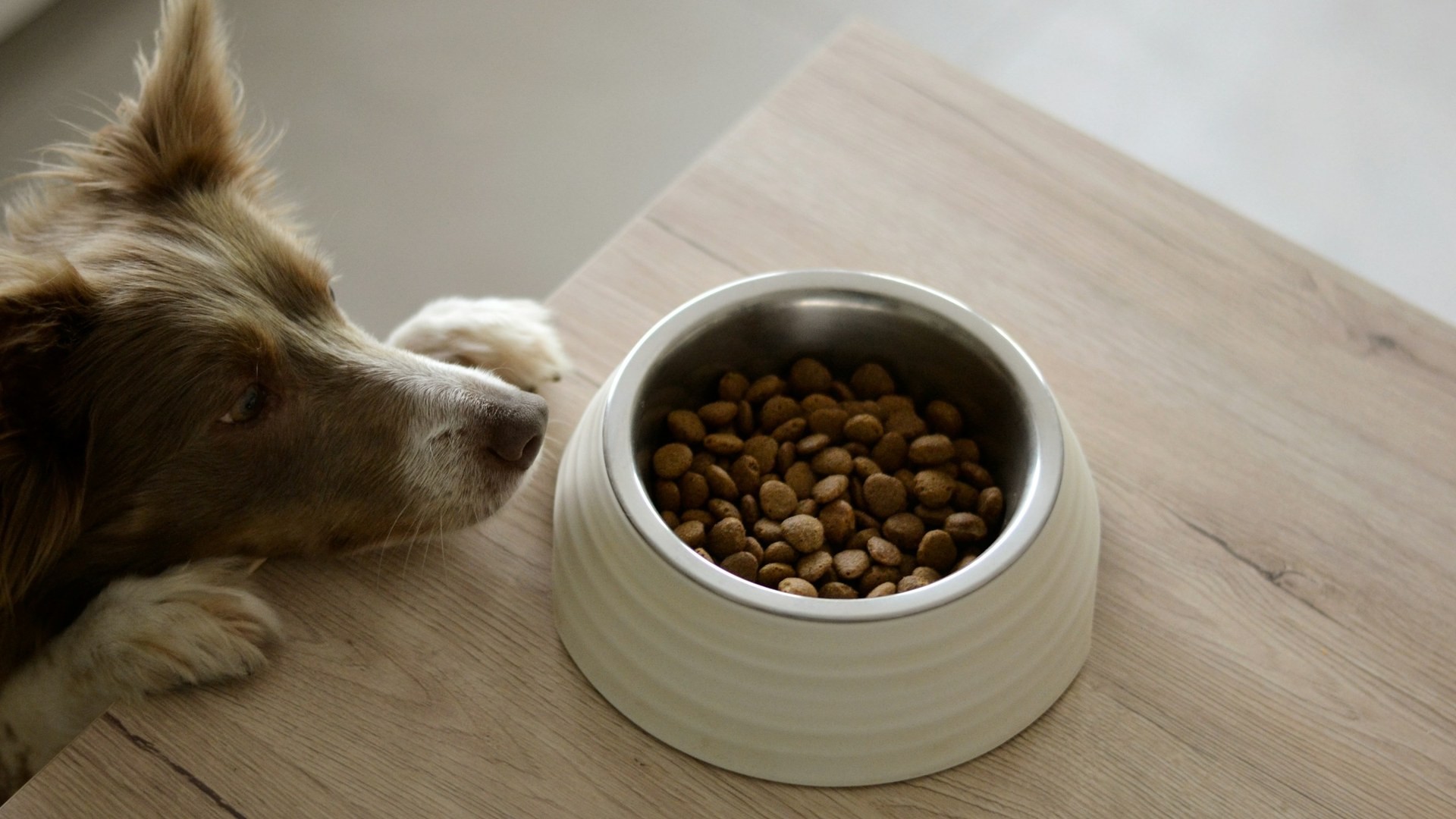
Blood, saliva and other convenient tests still cannot reliably diagnose a food allergy in a dog. A systematic review published online in the Journal of the American Veterinary Medical Association on October 23 examined 59 studies from 16 countries and found that the best-validated method remains the awkward one: feed a controlled elimination diet, then reintroduce the original food to see whether the signs return.
Why improvement after a food change is not enough
That conclusion matters because an itchy dog can look convincingly food-allergic while having flea allergy, environmental atopy, a skin infection or another problem. A dog that improves after a diet change has not completed the diagnosis either. Treatment of an infection, a seasonal change or tighter flea control may have occurred at the same time. The food challenge is what tests whether the old diet was actually part of the problem. 2026 JAVMA systematic review
What the new review found
The 2026 reviewers examined research published from 1986 through 2025. They grouped the evidence into elimination and challenge diets, blood tests, skin tests, cellular assays and molecular methods. The studies were too different for a pooled meta-analysis, which is an important limitation, but one result was consistent: the elimination diet test followed by oral food challenge had the strongest clinical validation. JAVMA: diagnosing adverse food reactions in dogs
Tests for food-specific IgG or IgE in blood and tests using saliva correlated poorly with clinical outcome. Standardised patch testing showed the strongest cutaneous performance, driven mainly by a high negative predictive value, but the review judged its practical value limited and did not support it as a replacement for the dietary test. Laboratory assays of immune-cell responses came closest to agreeing with a food challenge, yet remain specialised research tools rather than a routine answer for owners. JAVMA systematic review
A laboratory signal can show a biological response without establishing that the food causes this dog's illness. The review's practical conclusion is narrower and more consequential: no evaluated alternative reliably established the diagnosis well enough to replace elimination and challenge.
Symptoms can raise the question, not answer it
Persistent, nonseasonal itch is the main reason food allergy enters the discussion. Dogs may scratch generally or focus on their ears, feet or underside. Recurrent external-ear inflammation, bacterial or yeast skin infections, redness and self-trauma can occur. Some dogs also have diarrhoea, vomiting or more frequent bowel movements. Clinical signs of canine adverse food reactions Noncutaneous signs review
None of those signs belongs only to food allergy. The 2023 American Animal Hospital Association guideline says history and physical examination cannot distinguish food allergy from atopy by themselves. The once-popular idea that an "ears and rear" itch pattern identifies food allergy is not considered accurate. A veterinarian still needs to look for parasites, infection and other causes, and may need to treat those problems while a diet trial is planned. 2023 AAHA allergic-skin guideline
Food allergy is neither the explanation for every itchy dog nor so rare that it should be ignored. A 2017 evidence review found reported rates of only 1 to 2 percent among dogs presented for any veterinary diagnosis, but 9 to 40 percent among selected populations presented with itch. Those wide ranges reflect different clinical populations and study methods. They support testing the right patient, not diagnosing every patient from symptoms. Prevalence review of canine adverse food reactions
The common-ingredient list is not a shopping blacklist
A frequently cited 2016 review collected challenge-confirmed food reactions reported in 297 dogs. Beef appeared in 102 dogs, dairy in 51, chicken in 45 and wheat in 38. Soy, lamb, corn and egg were reported less often. Mueller et al. 2016 ingredient review
| Reported food source | Dogs in the 297-dog evidence set | Share of the evidence set |
|---|---|---|
| Beef | 102 | 34% |
| Dairy products | 51 | 17% |
| Chicken | 45 | 15% |
| Wheat | 38 | 13% |
| Soy | 18 | 6% |
| Lamb | 14 | 5% |
| Corn | 13 | 4% |
| Egg | 11 | 4% |
Table adapted from Mueller et al. 2016 under CC BY 4.0. Some dogs reacted to more than one food, and uneven or incomplete rechallenge protocols limit comparisons. Source table: Mueller et al. 2016 Creative Commons Attribution 4.0
The table does not show the chance that any randomly chosen dog will become allergic to an ingredient. Most of the underlying studies challenged only a limited selection of foods, previous diet histories were often missing, and rechallenge protocols were uneven or incomplete. The authors warned that the ranking may partly reflect what dogs were commonly fed during the decades covered by the reports. Food allergy generally requires prior sensitisation, but diet histories can miss undeclared exposure and related proteins may cross-react, so "never eaten" is not always as certain as it sounds.
That is why "avoid beef and chicken" is not a diagnostic plan. A dog can react to a less frequently reported food, and another dog may tolerate every item in the table. The list is useful when a veterinarian plans later ingredient challenges. It is not a universal list of bad ingredients and does not justify replacing a complete diet without a clinical reason.
There is no dependable six-hour or 24-hour rule
Chronic food-related itch does not necessarily appear after one obvious meal. A dog can have eaten the same source for a long time before a problem is investigated, and the visible signs can be maintained by secondary skin or ear infection. A sudden stomach upset after a food switch may reflect the change itself, another illness or an adverse reaction, but timing alone cannot identify an allergy.
The best timing evidence comes from dogs whose skin signs had already improved on an elimination diet and who were then challenged with the old food or an ingredient. A 2020 synthesis found 315 time-to-flare observations from 234 dogs, because one dog could undergo more than one challenge. About 9 percent of the recorded cutaneous flares appeared on the first day and 21 percent by the end of the second day. Half had appeared by day five, while 90 percent had done so by day 14. The reviewers also warned that first-day reactions may have been underreported. Time-to-flare review
Those figures directly contradict a universal claim that a food allergy must become visible within 6 to 24 hours. They also explain why an apparently uneventful first bowl does not clear an ingredient. Challenge timing should be agreed with the veterinarian, particularly when the dog's previous reaction involved more than chronic itch or digestive signs.
A diagnostic diet is stricter than trying a different bag
The elimination phase restricts exposure to intact dietary antigens likely to provoke signs while still providing an appropriate diet. The choice usually falls into one of three categories: a veterinary hydrolysed diet whose proteins have been broken into small fragments, a veterinary diet built around a genuinely novel protein and carbohydrate for that dog, or a nutritionally appropriate home-cooked diet formulated for the individual dog by a veterinarian or veterinary nutrition specialist. A hydrolysed diet may use a protein source the dog has eaten before; its purpose is to change the form of that protein, not simply to find a new ingredient. The dog's complete diet history, age, health, preferences and the owner's practical limits determine the choice. AAHA dietary-trial guidance
AAHA recommends a 4 to 12 week clinical plan and notes that eight weeks may be needed to identify more than 90 percent of food-allergic dogs. A small group may need as long as 12 weeks for the itch to settle fully. Stopping after a few good days or one month can therefore produce a false negative. AAHA 2023 guideline
For a true diagnostic trial, the selected diet must be the only food that passes the dog's lips. The guideline explicitly includes treats, table scraps, cat food, flavoured pill pockets, edible or flavoured toys, scavenged faeces and access to shared bowls among the possible leaks. Flavoured medicines and preventives need to be discussed with the veterinary team rather than stopped independently. AAHA 2023 guideline
Over-the-counter limited-ingredient foods can be useful as ordinary diets, but AAHA does not treat them as equivalent to veterinary therapeutic diets for a rigorous trial. Undeclared protein sources have been found in some products, and even a small exposure can make a negative result hard to interpret. When cost rules out the preferred option, the owner and veterinarian can decide what compromise is feasible and label the result honestly as a diet change rather than a fully controlled test. AAHA 2023 guideline
Measure the trial before deciding that it worked
Write down a baseline before the first meal: itch severity, affected body areas, ear signs, stool frequency and consistency, vomiting, current skin infection and every treatment being used. Take comparable photographs of visible lesions. Then record the same observations weekly. Memory tends to compress a variable eight-week course into "better" or "not better," while a simple record can show whether the feet improved but the ears did not, or whether the stool changed before the skin.
Concurrent treatment is not automatically a mistake. A dog should not be left uncomfortable or infected merely to protect an experiment. The veterinary plan must account for how anti-itch medication, antibiotics, antifungals and parasite control affect interpretation. AAHA suggests a planned recheck and timing changes to itch medication so the response to diet can be assessed rather than guessed. AAHA 2023 guideline
If there is no meaningful improvement, first audit the trial. Confirm the dog ate the intended diet for long enough and look for hidden exposures or an untreated infection. If the trial was genuinely strict, the result makes food allergy less likely and helps redirect the investigation. Repeated unsupervised switches make the exposure history harder to interpret and can reduce the number of genuinely novel ingredients available for a later controlled trial.
Improvement is only phase one; the challenge confirms it
When signs improve substantially, the next step is not automatically a lifetime prescription. The veterinary team plans a challenge by reintroducing the original diet, then watches for the documented signs to return. A relapse connects the improvement to removal of the old food. Improvement again after the elimination diet resumes strengthens that conclusion.
AAHA calls the challenge essential because improvement alone can coincide with other changes. Without it, a dog may stay on an expensive restrictive diet for years even though seasonal atopy, parasite control or treatment of an infection caused the change. The 2020 timing review indicates that observing for as long as 14 days captures more than 90 percent of skin flares after challenge. AAHA 2023 guideline Time-to-flare review
A challenge should not be improvised when the previous history suggests a severe immediate reaction. Although anaphylaxis associated with food has been reported in dogs, it was rare and weakly supported in a review of non-skin manifestations. A veterinarian should decide whether, how and where re-exposure is appropriate for the individual dog. Noncutaneous signs review
Food intolerance and a rapid diet switch are different questions
"Adverse food reaction" is often the more honest umbrella term while the cause is being investigated. An immune-mediated allergy and a non-immune intolerance can overlap in their digestive signs, and neither is diagnosed by the marketing label on a bag. Vomiting or diarrhoea after a rapid switch can also occur without allergy.
An ordinary food transition and a diagnostic elimination trial answer different questions. Mixing the old and new foods throughout an allergy trial would preserve the very exposures the test is designed to remove. The veterinarian should say explicitly whether the immediate goal is managing a routine food change, nutritional treatment or diagnosis, and how the selected diet should be introduced for that dog.
Do not explain a seizure with a food-allergy theory
Seizures are not part of the typical pattern used to identify canine food allergy in the evidence reviews and clinical guideline above. A seizure in an itchy dog therefore needs its own assessment. Assuming that food caused it can delay investigation of toxins, metabolic disease, epilepsy, structural brain disease or another urgent problem. Clinical signs of canine adverse food reactions ACVIM seizure consensus
During a seizure, move hard or sharp objects away, keep hands out of the dog's mouth and time the episode. A seizure lasting more than five minutes, repeated seizures in a short period, failure to recover normally, collapse or breathing difficulty requires immediate veterinary care. Even a short first seizure warrants veterinary contact to decide what evaluation is needed. Articleous has a separate guide to the signs that should send a dog to emergency care. VCA: common emergencies in dogs Articleous emergency-vet guide
The owner checklist that makes the slow test useful
Before starting, be able to answer these questions with the veterinary team:
- What other causes of itch, ear disease or digestive signs have been checked or treated?
- What has the dog eaten before, including treats, chews, supplements and flavoured medicines?
- Which hydrolysed, novel-protein or formulated home-cooked diet fits this dog's history and nutritional needs?
- How long will the elimination phase run, and when are the rechecks?
- Which exposures are forbidden, and what will replace necessary flavoured medication or rewards?
- Which signs will be scored each week?
- What degree of improvement will count as a response?
- How will the original diet be challenged, and which previous reactions make home challenge inappropriate?
The useful outcome is not a longer list of ingredients to fear. It is a result the owner and veterinary team can interpret: either the controlled trial and challenge support a food cause, or the investigation can move on without treating a convenient panel as certainty.
Sources
- JAVMA: systematic review of canine food-allergy tests
- AAHA: 2023 management of allergic skin diseases guideline
- Mueller et al. 2016: commonly reported food allergens
- Olivry and Mueller 2020: time to flare after challenge
- Prevalence review of canine adverse food reactions
- Clinical signs review
- Noncutaneous signs review
- ACVIM consensus on seizure management
- VCA: common emergencies in dogs
- Lead photograph by Ayla Verschueren on Unsplash
- Unsplash License