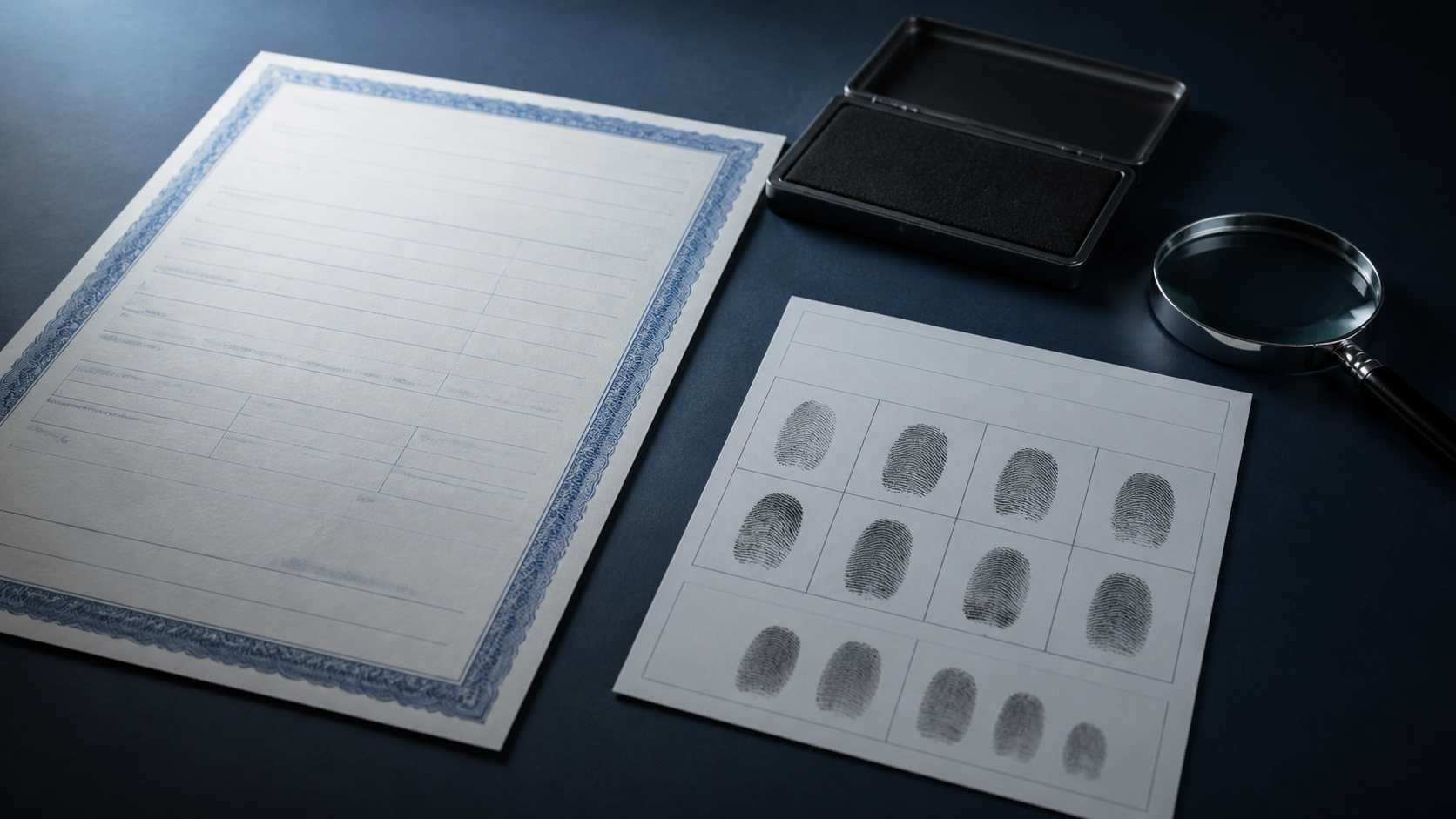
The standard US death certificate has no fingerprint field. Prints may still be collected in a separate identification file or offered as a memorial keepsake, depending on the case and jurisdiction.
The short answer
In the United States, the standard death certificate does not contain fingerprints. The Centers for Disease Control and Prevention form records such details as the deceased person’s name, age, residence, place and time of death, disposition, cause and manner of death, and the certifying professionals. It has no field for a print or fingerprint image. CDC standard death certificate
That does not mean fingerprints are never taken after death. A medical examiner, coroner or law-enforcement agency may use prints to help establish identity, while a funeral home may make a separate print for a family keepsake. Those are different records, held for different reasons and under different access rules.
A certificate documents a death; a print helps establish identity
A death certificate is a civil vital record. Its job is to register that a death occurred and preserve the facts needed for public health, legal administration and family affairs. The funeral director commonly supplies demographic and disposition information; a medical certifier supplies the cause-of-death portion.
Fingerprints belong to the identification process rather than the certificate itself. New York City’s medical examiner, for example, lists fingerprint comparison among the scientific methods that may be used to identify a person. The method chosen depends on the condition of the remains, available records and the circumstances of the case. NYC medical-examiner identification guidance
That separation explains an apparent contradiction families sometimes encounter: a death certificate can be issued without displaying a fingerprint even when a separate agency file contains prints used during identification.
Who might take fingerprints after death?
In an investigated or unidentified death, an authorized official may collect postmortem fingerprints and compare them with known records. Difficult cases can require specialist techniques because skin condition changes after death; forensic literature describes methods for restoring ridge detail or collecting prints from compromised hands.
The FBI’s biometric exchange specification includes transactions and records designed for unidentified deceased persons. It is a technical framework for agencies—not a promise that every death generates a searchable fingerprint record. FBI biometric specification Forensic review of postmortem fingerprints
A funeral home may also make a memorial print for jewellery, artwork or a family archive. That commercial or personal service is not part of the government death certificate, and it should not be confused with a forensic identification record.
What families should ask for
Start by naming the document you need. If you need proof of death for an estate, insurer or account closure, ask the relevant vital-records office or funeral director about certified copies of the death certificate. If you want a memorial fingerprint, ask the funeral home whether one was taken and what consent, storage and deletion practices apply.
If the death was handled by a medical examiner or coroner and you are seeking an identification record, contact that office directly. Access rules vary by state and locality, and some material may be restricted because it belongs to an investigation or contains sensitive personal information.
Do not assume that a funeral home can retrieve a print from a government database, or that a certificate can be amended to add one. A memorial print, a forensic identification record and a civil death certificate are separate records created for different purposes.
The useful distinction
The clearest answer is therefore three-part: no fingerprint appears on the standard US death certificate; a separate forensic fingerprint record may exist in some cases; and a funeral provider may create a separate memorial print if the family requests or permits it.
Because law and practice differ across jurisdictions, the office that created the record is the only reliable place to confirm whether a particular print exists and who is entitled to receive it.